
Table of Contents
CEOs fear losing their jobs over AI failure—and 80% of global CEOs now believe their role is at risk if AI fails to deliver measurable results by the end of 2026.
Eighty percent of global CEOs now believe their own job is at risk if their company fails to deliver measurable results from AI by the end of 2026. That figure comes from a Harris Poll survey of 900 CEOs conducted on behalf of Dataiku — and it’s up sharply from 74% just one year earlier.
In the United States, the number climbs to 81%, and a similar share of American CEOs believe a peer will be pushed out this year over a failed AI strategy.
This is not innovation-team anxiety. This is boardroom accountability, and it now sits directly on the desk of the person running the company.
Picture the pattern playing out in boardrooms right now: a CEO stood in front of the board eighteen months ago with a bold AI roadmap and got the green light. Budgets were approved. Vendors were signed. Then the board asked for the numbers — and the numbers weren’t there. That scene, in some version, is repeating across thousands of companies this year. The pressure is real, it is global, and it is landing squarely on CEOs.
This article lays out why that pressure is building, what the data says about where AI investment is actually failing, and a concrete framework you can use to turn AI from a career liability into your strongest competitive advantage before the year is out.
Why CEOs Fear Losing Jobs AI: The AI ROI Crisis
The fear CEOs are feeling isn’t irrational — it’s a direct response to a widening gap between AI spending and AI results.
This is exactly why CEOs fear losing their jobs—they cannot yet connect what they invested to what it produced.”
According to PwC’s 29th Global CEO Survey of 4,454 CEOs across 95 countries, only 30% of CEOs are confident about revenue growth over the next 12 months, down from 38% in 2025 and 56% in 2022 — the lowest reading in five years. The same survey found that 56% of CEOs report their company has seen no significant financial benefit, in cost savings or revenue, from AI to date. Only 12% say AI has delivered gains on both fronts.
That gap between investment and return is exactly what’s driving the fear. Boards approved the spending on the promise of transformation. Now they want proof, and most CEOs don’t have it yet.
Layered on top of the ROI gap is direct board pressure. Dataiku’s research found that 62% of CEOs globally — and 72% in the U.S., up from 61% a year earlier — say their boards are actively pushing them to deliver measurable AI outcomes. Investors are asking the same question in earnings calls. The result is a CEO population that is financially exposed, publicly scrutinized, and often unsure which of their AI initiatives are actually working.
This is the crisis underneath the crisis: most CEOs aren’t struggling because they under-invested in AI. They’re struggling because they can’t yet connect what they invested to what it produced.
The Data: The Proof This Is a Global Crisis

The scale of this disconnect shows up clearly in how much capital is moving versus how much of it is validated.
BCG’s 2026 AI Radar, based on a survey of 2,360 executives including 640 CEOs across 16 markets, found that companies plan to roughly double AI spending in 2026, from 0.8% to about 1.7% of revenue. What’s striking is the resolve behind that spending: 94% of organizations say they’ll continue or even expand AI investment even if it fails to deliver returns in the next 12 months. Only 6% would pull back. That’s conviction — but it’s also exactly the kind of momentum that outruns discipline.
Half of the CEOs in that same BCG survey said their job stability now depends on getting AI strategy right. And separately, Gartner’s May 2026 research found that roughly 80% of organizations that used AI to justify workforce reductions have seen no measurable ROI from those cuts — a sobering data point for any CEO who treated AI-driven layoffs as a shortcut to margin improvement rather than a genuine strategic bet.
Consider the shape this typically takes inside a company. One organization pours budget into a broad AI rollout — dozens of pilots, multiple vendors, no single owner accountable for outcomes — and eighteen months later can’t point to a P&L line that moved.
Another organization picks one function, gives it a real budget and a real owner, and sets a 90-day checkpoint. The second company isn’t smarter or better funded. It just has a stricter operating discipline. That gap between undisciplined enthusiasm and focused execution is, in miniature, the entire AI ROI crisis playing out across the corporate world in 2026.
Adding to the pressure, Bain & Company’s 2026 analysis argues that the era of a single global operating environment for business strategy has effectively ended. CEOs can no longer run one AI playbook across every market — tariffs, regulation, and regional AI maturity now force a more fragmented, market-by-market approach, which only adds complexity to an already difficult accountability problem.
The Framework: A 3-Step System to Secure Your Position
If you’re a CEO reading this, the good news is that the fix isn’t more AI spending. It’s more discipline around the spending you’ve already committed. Here’s a three-step framework to get measurable results by the end of 2026.
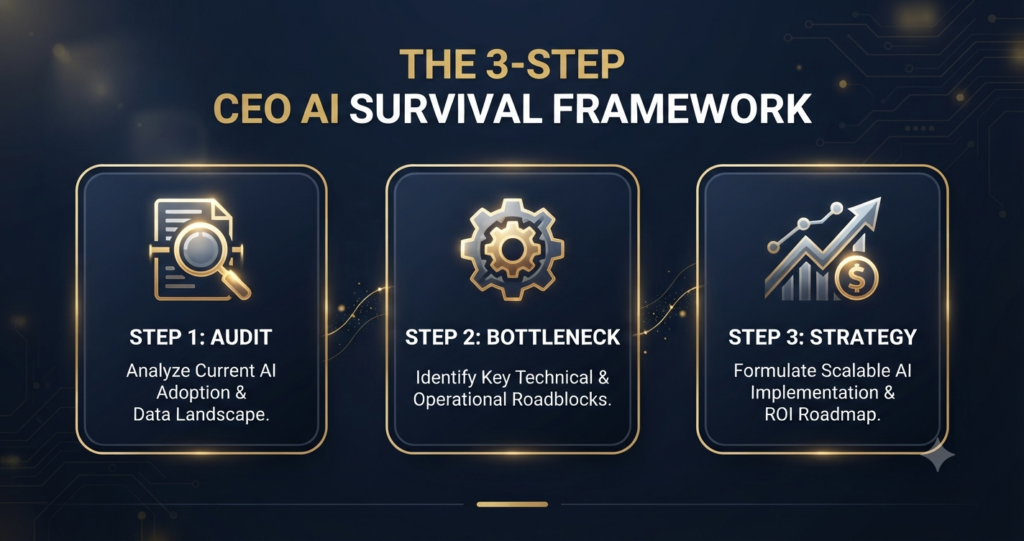
Step 1: Audit Your Current AI ROI
Before adding a single new initiative, find out what you already have and whether it’s working.
- Stop funding AI projects that have no clear line to revenue or cost savings.
- List every active AI initiative and map each one to a specific, measurable business outcome — not “efficiency” or “innovation,” but a number.
- Anything that can’t be mapped to a number within 30 days goes on a watch list for defunding.
A disciplined audit like this typically surfaces a meaningful chunk of spend — often 20–30% — sitting in pilots and tools with no owner and no metric attached. Cutting that dead weight doesn’t just save money; it frees up budget and attention for the initiatives that are actually working.
Step 2: Identify Your Biggest Operational Bottleneck
Once you know what’s working, concentrate your AI investment where it will move the needle most, rather than spreading it thin across every department.
- Apply the 80/20 rule: identify the one function — customer service, sales, or core operations — where AI can produce the biggest measurable return, and commit most of your budget there.
- Resist the instinct to run a dozen small experiments simultaneously.
Trailblazing companies in BCG’s research concentrate investment and see it show up in confidence and results; the majority of companies that spread bets thinly are the ones stuck reporting no ROI.
If you want to see how concentrated AI execution translates into company valuation, this connects directly to my guide on 31x vs 13x: The AI Valuation Gap That Doubles Company Worth in 2026 and the widening multiple gap between AI leaders and laggards — worth reading as a companion piece to this framework.
Step 3: Build a Clear AI Strategy with Measurable Milestones
Strategy without a scoreboard is just hope. Give your board — and yourself — something concrete to track.
- Set quarterly, numeric targets for your priority AI initiative.
- Put the whole plan on three pages: what you’re doing, why, and how you’ll know it worked.
- Report progress to your board on a fixed cadence, even when the news is mixed. CEOs who show up with real numbers, good or bad, build more credibility than ones who show up with vague optimism.
This same shift — from experimentation to accountable, milestone-driven execution — is also reshaping how professional services firms price and structure their work, which is worth exploring separately if your business model still runs on time-based billing.
The 90-Day Action Plan: From Fear to Dominance
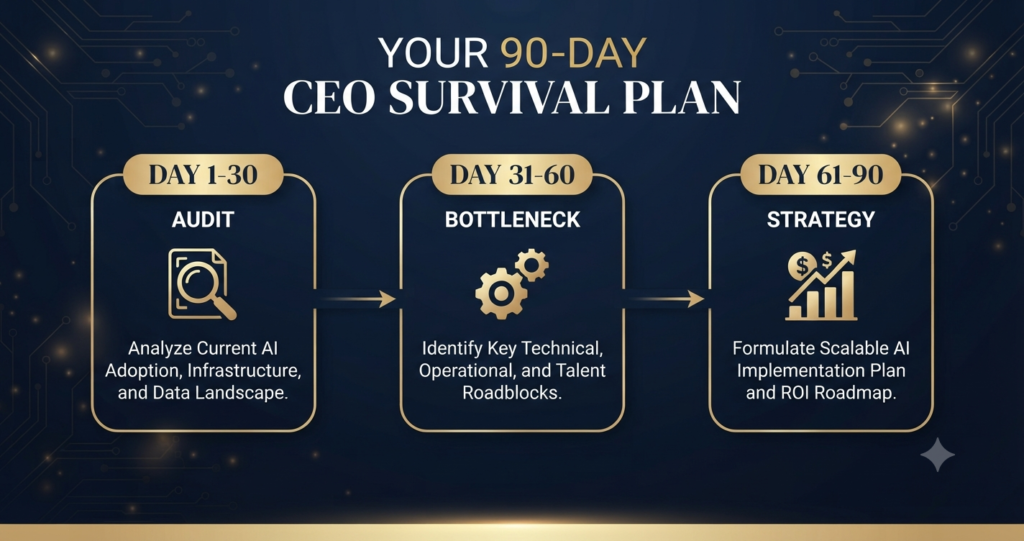
Days 1–30: Audit your current AI investments.
Map every active AI tool or initiative to a specific business outcome. Identify which are delivering measurable ROI and which aren’t. Set a target to cut or pause underperforming initiatives by at least 20%, redirecting that budget toward what’s working.
Days 31–60: Identify your biggest operational bottleneck.
Analyze where AI can deliver the largest measurable impact — most commonly customer service, sales conversion, or core operations. Commit the majority of your remaining AI budget to that single area rather than spreading it across the organization.
Days 61–90: Build your strategy and set measurable milestones.
Write the three-page strategy document. Set quarterly KPIs tied to revenue or cost. Present the plan and the numbers to your board with specifics, not generalities.
CEOs who run this sequence enter Q1 2027 with something rare in this environment: a defensible, board-ready account of what AI has actually done for their business.
Your Next Step: Secure Your Position and Dominate Your Market
The message from this year’s data is consistent across BCG, PwC, and Dataiku: CEOs who act with discipline now — auditing spend, focusing on one bottleneck, and reporting real milestones — will be the ones still standing at their board table in 2027. Those who keep spreading AI investment thin without proof of return are the ones most exposed.
CEOs fear losing their jobs if they don’t act now—but those who move with discipline will dominate the next decade.
If you want a personalized AI audit for your company, Book a Free Strategy Call and let’s map out where your AI investment is working, where it isn’t, and what to do about it before your next board meeting.
Frequently Asked Questions
Q 1: Is this really a global CEO concern?
Yes. The Dataiku/Harris Poll survey covered 900 CEOs across the U.S., U.K., France, Germany, the UAE, Japan, South Korea, and Singapore, all at companies with revenue above $500 million or the regional equivalent. The 80% figure is a global average across those markets.
Q 2: Why are CEOs so worried about AI failure specifically now?
Because the runway for experimentation has closed. Boards spent 2023–2025 tolerating pilots and learning curves; in 2026, they’re demanding proof. Dataiku’s companion CIO research found 71% of CIOs believe they have until mid-2026 to demonstrate AI value before budgets or roles are cut — and CEOs are facing the same deadline from their boards.
Q 3: What happens if CEOs ignore this pressure?
Based on the survey data, the range of consequences includes board pressure escalating into leadership changes, missed competitive positioning as AI-mature rivals pull ahead, and — per PwC’s findings — a widening profit-margin gap between companies that have scaled AI with strong foundations and those still stuck in pilots.
Q 4: What’s the single biggest mistake CEOs make with AI?
Investing broadly without a strategy for proving return. BCG found that 94% of companies plan to keep investing even without near-term returns — which is fine as a long-term bet, but dangerous without a parallel discipline for measuring what’s working now.
Q 5: Can smaller businesses apply this survival plan?
Yes. The three-step framework — audit, focus on one bottleneck, set measurable milestones — scales down as easily as it scales up. Smaller organizations often have an advantage here: fewer initiatives to audit and less organizational inertia to redirect.
Q 6: What’s the first concrete step?
Audit your current AI investments this week. Before you spend another dollar on a new tool or pilot, know exactly what you’re already running and whether any of it is producing a number your board would recognize as a result.
Conclusion
The window to get ahead of this pressure is closing, but it isn’t closed. CEOs who move now — auditing what they’ve built, concentrating investment where it counts, and reporting real milestones instead of ambition — will be the ones who turn 2026’s AI reckoning into a competitive advantage.
The ones who keep spending without proof are the ones the data says are most exposed. The choice, and the next 90 days, are yours.