
Table of Contents
CEO stress 2026 is at an all-time high—70% of global CEOs are running on clinically high stress levels.
Seventy percent. Read that number twice.
That’s the share of CEOs worldwide who are currently operating with clinically high stress levels — not “busy,” not “under pressure,” but at a threshold that clinical psychology treats as a health concern. The number comes from BCG’s inaugural CEO Insomnia Index, a 2026 study of roughly 500 chief executives at companies ranging from $100 million to more than $5 billion in revenue.
The average stress score across the group: 66.7 out of 100. That is not a wellness footnote. 70% of CEOs are running on clinical stress, and the 2026 survival plan starts with admitting that the job itself has changed.
This isn’t an article about burnout in the abstract. It’s a working framework — the same one I use when I sit across from founders and boards — for identifying exactly where your time is leaking, which risks you’re not seeing, and how to rebuild the strategic bandwidth the role was always supposed to protect.
Section 1: The Diagnosis
70% of CEOs are running on clinically high stress levels. This is not a wellness issue — it is a strategic crisis.
Here’s what the data actually shows:
- More than 70% of CEOs report clinically high stress, with an average score of 66.7/100 — above the clinical threshold.
- 57% say near-term issues now consume a disproportionate share of their time.
- Deloitte’s research adds a second layer to this: a large majority of executives describe exhaustion that doesn’t resolve with rest, vacation, or time off. This isn’t ordinary fatigue. It’s a chronic state.
Put those together and a picture emerges: the CEO role has quietly shifted from strategic architect to emergency manager. Boards still expect five-year vision. Investors still expect market foresight. But the actual hours in a CEO’s week are being consumed by the next fire, the next escalation, the next Slack message marked urgent. This is the core tension behind 70% of CEOs are running on clinical stress — the 2026 survival plan exists precisely because the old playbook for leadership no longer matches the job as it’s actually being lived.
Consider the typical experience of a mid-market industrials CEO—a composite drawn from multiple conversations I have had with leaders in similar roles. One described her week as ‘eleven fires and zero strategy sessions.’ She hadn’t opened her three-year roadmap in six weeks—not because she didn’t care about it, but because nothing on her calendar protected the time to think about it.
Section 2: The Urgency Trap
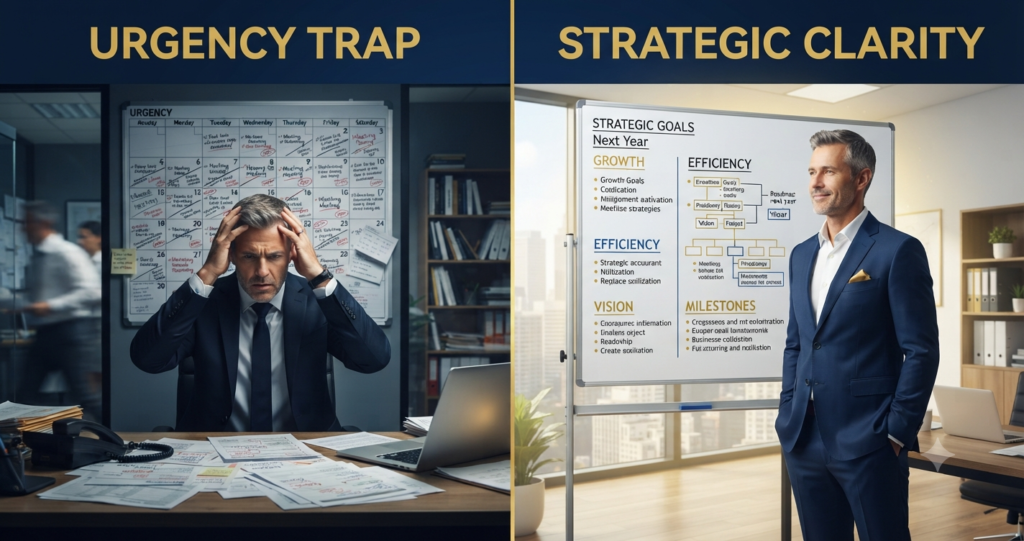
CEOs are not stressed because they are bad at their jobs. They are stressed because the role has fundamentally changed shape. It is no longer primarily about strategy — it is about managing a continuous, compounding flow of emergencies, each one competing for the same finite hours that used to be reserved for thinking ahead.
The numbers back this up:
- 60% of CEOs expect challenging or very challenging operating conditions in the months ahead. They can see the storm forming — they just don’t have the runway to prepare for it.
- Short-term issues are absorbing more than half of most CEOs’ working time.
- There’s a paradox at the board level: the vast majority of CEOs report feeling aligned with their board, yet a significant share also feel they have more to prove than they did six months ago. Alignment and pressure are rising together, not trading off against each other.
This is the same dynamic reshaping entire professional categories, not just individual calendars. Traditional business models built around billable hours and linear execution are being compressed the same way CEO time is being compressed — a shift I’ve broken down in detail on how AI is Killing the Billable Hour: The CEO’s 10-Year Survival Guide to the Consulting Takeover , which looks at how leadership teams across consulting, legal, and advisory functions are being forced to rethink what they charge for and how they spend their time.
The deeper problem isn’t the volume of urgent tasks. It’s that urgency, left unmanaged, becomes the operating system of the entire company. Every layer below the CEO learns to escalate instead of decide, because escalating is what gets rewarded when the person at the top is visibly firefighting.
Section 3: The Blind Spots
Here’s what separates a strategic advisor from a headline writer: knowing not just what CEOs are stressed about, but what they’re not stressed about — and shouldn’t be ignoring.CEOs are so focused on immediate performance metrics that three structural threats are quietly building underneath them.
Blind Spot 1 — Activist Investors
Activist investors rank near the bottom of most CEOs’ concern lists. But shareholder activism is associated with a 24% increase in the probability of CEO turnover. This isn’t a distant, eventual risk — it’s a structural one, sitting in the blind spot precisely because it doesn’t generate daily noise the way an operational fire does.
Blind Spot 2 — Employee Dissatisfaction
A relatively small share of CEOs list employee dissatisfaction as a top priority. Yet workforce sentiment is one of the clearest early indicators of execution risk — the people closest to the strategy are usually the first to sense when it isn’t working. Ignoring this signal doesn’t make the risk disappear; it just delays when it surfaces, usually at a worse moment than now.
Blind Spot 3 — AI Pressure, the Ticking Clock
AI ranks ninth out of eleven sources of CEO stress — near the bottom. Most CEOs report feeling more energized than anxious about it. But underneath that optimism sits a harder number: a meaningful share of CEOs already feel real urgency to prove AI’s return on investment, and that share is climbing fast. Most CEOs personally own the AI decision at their company, which means the accountability sits with them even while the stress hasn’t caught up yet.
That gap — between capital already committed to AI and returns that boards can actually see — is widening, and it’s not a minor footnote. It’s increasingly the difference between companies that command premium valuations and companies that don’t. I’ve mapped this out in detail in 31x vs 13x: The AI Valuation Gap That Doubles Company Worth in 2026 , which shows how companies using AI with real strategic discipline are trading at multiples that dwarf their less-focused peers.
This is the blind spot inside 70% of CEOs are running on clinical stress — the 2026 survival plan has to treat AI ROI not as a technology question, but as a board-level accountability question that’s coming due faster than most leadership teams expect.
Section 4: The Framework — Three Steps to Escape the Urgency Trap
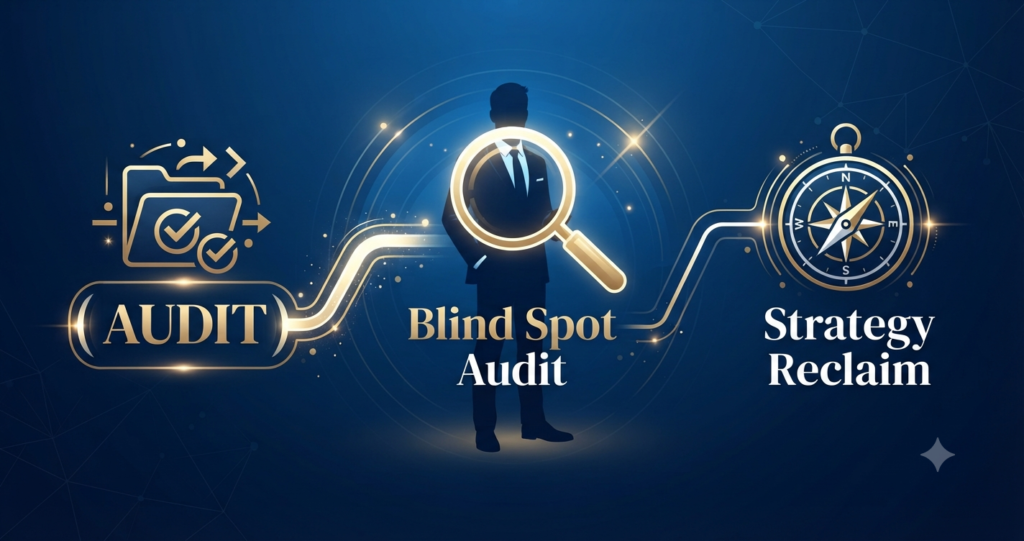
There is no silver bullet here. Anyone who promises you a 48-hour fix to structural CEO burnout is selling something. What actually works is a disciplined, three-step reset.
Step 1: Audit Your Time and Stress
| Action | How to Do It |
|---|---|
| Track your time for two weeks | Log every meeting, decision and interruption. You cannot fix what you haven’t measured. |
| Identify “urgent but not important” tasks | For each one, ask: delegate, automate, or eliminate? |
| Measure your cognitive load | Are your decision in week two as sharp as they were in week 1? Or are you running on empty by Thursday? |
If you do not audit your time, urgency will audit it for you.
One logistics CEO I have worked with—part of a broader pattern I have observed across multiple leadership teams—ran this exact two-week audit and discovered that 40% of his calendar was recurring status updates he didn’t need to personally attend. Cutting them freed up nine hours a week—enough to reinstate a strategy session he’d quietly dropped eighteen months earlier.
Step 2: Identify Your Blind Spots
| Action | How to Do It |
|---|---|
| Run a Blind Spot Audit | Where is your attention concentrated, and what structural risks sit outside that spotlight? |
| Assess your board relationship honestly | Are you aligned on strategy- or just aligned on optics? |
| Check real employee sentiment | Not the engagement survey summary-the unfiltered version. |
The threats you ignore are the ones that will ultimately remove you.
Step 3: Reclaim Strategy
| Action | How to Do It |
|---|---|
| Protect strategic time | Block 2-4 uninterrupted hours weekly. Treat it like board meeting because it deserves to be one. |
| Defer operational decisions | Push day-to-day calls down to your leadership team. If everything routes through you, nothing scales. |
| Shift your metrics | Track competitive moats and long-term positioning,not just this quarter’s efficiency numbers. |
Strategy is not what you do when you have time. Strategy is what you protect time for.
This three-step framework is the engine of 70% of CEOs are running on clinical stress — the 2026 survival plan, because it converts a vague sense of overwhelm into a concrete, repeatable operating rhythm.
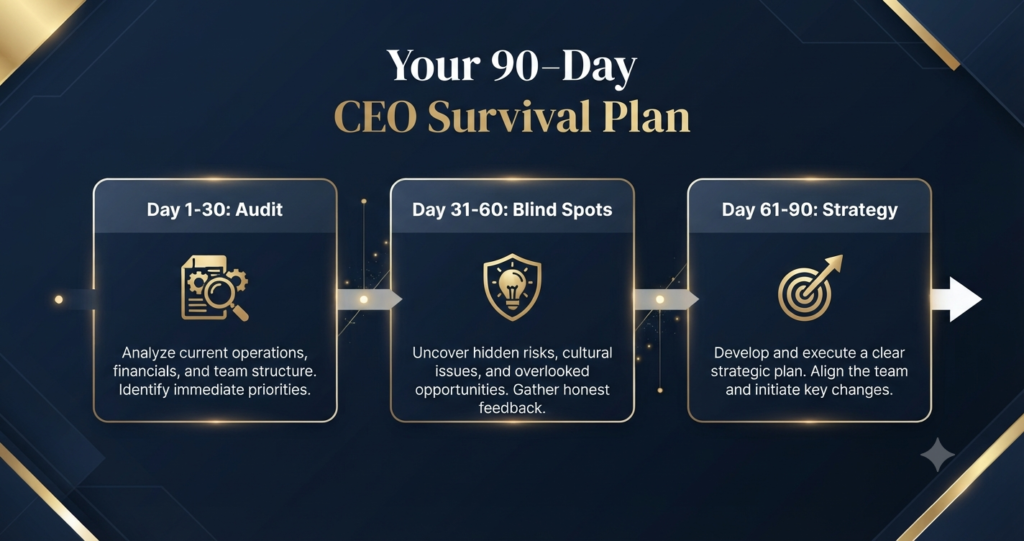
Section 5: Your 90-Day Action Plan — From Urgency to Strategic Clarity
Days 1–30: Audit Your Time and Stress
Track your time for two full weeks; identify exactly what consumes your day.Delegate or eliminate every “urgent but not important” task you find.Measure your cognitive load and decision quality across the audit period.
“A common case: a Southeast Asian fintech founder used her first 30 days to discover she was personally approving expense reports under $500—a task costing her four hours a week that any finance manager could own. That single change gave her back a full strategy day each month.”
Days 31–60: Identify Your Blind Spots
- Run a full Blind Spot Audit covering activist investors, employee sentiment, and AI ROI pressure.
- Assess your board relationship and genuine employee engagement, not the sanitized version.
- Address emerging gaps before they escalate into board-level crises.
Days 61–90: Reclaim Strategy
- Block 2–4 protected hours weekly for uninterrupted strategic thinking.
- Defer routine operational decisions permanently to your leadership team.
- Shift your core metrics toward competitive moats and durable advantage, not just quarterly efficiency.
Section 6: The Choice in Front of You
The CEOs who act now — who audit their time, identify their blind spots, and reclaim strategy — won’t just survive 2026. They’ll be positioned to dominate the decade that follows. The ones who keep spreading themselves thin without a plan are the ones this data is quietly warning about. Download the CEO Resilience Audit Checklist to run your own time audit, surface your blind spots, and begin reclaiming strategic focus this week.⬇️
Want a personalized read on where your leadership team is losing time and where the blind spots actually sit? Book a Free 15-Minute Strategy Call and we’ll map it out together — no generic advice, just your calendar and your risk profile.Prefer to start on your own?
Frequently Asked Questions
Q 1: Is this really a global concern, or just a U.S. phenomenon?
Global. The BCG CEO Insomnia Index surveyed roughly 500 CEOs at companies with revenues from $100 million to more than $5 billion, spanning multiple countries and industries.
Q 2: Why are CEOs so stressed right now specifically?
Not because they’re worse at the job than previous generations — because the job itself has shifted. It’s moved from strategic architecture toward continuous emergency management, driven by tighter board scrutiny, compressed timelines, and faster-moving competitive threats. The pressure is structural, not personal.
Q 3: What’s the single biggest blind spot CEOs have?
It’s a tie between three: activist investors, employee dissatisfaction, and AI ROI pressure. All three are statistically linked to turnover risk, and all three currently rank low on most CEOs’ day-to-day concern lists — which is exactly what makes them dangerous.
Q 4: Is the 70% statistic actually accurate?
Yes. It comes from BCG’s CEO Insomnia Index, based on a global survey of roughly 500 CEOs combined with multi-year CEO turnover analysis across the S&P 1200.
Q 5: How long does it realistically take to escape the urgency trap?
The 90-day framework above is a realistic, honest timeline — not a weekend fix. Expect meaningful shifts by day 30, structural change by day 90, and full habit formation somewhere beyond that.
Can smaller businesses and founders use this framework too?
Yes, and in some ways it scales down more easily than it scales up. Smaller organizations often have fewer entrenched processes to audit and less institutional inertia to redirect — the same three steps apply, just with a shorter list to work through.
Conclusion
The window to get ahead of this pressure is closing, but it isn’t closed yet. CEOs who move now — auditing their time, identifying their blind spots, and reclaiming strategy — will be the ones who turn 2026’s leadership reckoning into a durable competitive advantage. The ones who keep spreading themselves thin without proof of return are the ones the data says are most exposed.
70% of CEOs are running on clinical stress. The 2026 survival plan isn’t complicated — it’s disciplined. The choice, and the next 90 days, are yours.