
AI strategy failure in 2026 is one of the most uncomfortable open secrets in business—CEOs are spending billions on AI with no measurable return.
Table of Contents
It’s past midnight in Lagos. Somewhere in Victoria Island, a founder is still at her desk, laptop glowing, three AI dashboards open in different tabs.
In Austin, a SaaS CEO is doing the same thing at 11 p.m. local time. In London, a CFO is scrolling through a board deck due in nine hours, trying to figure out how to answer the one question every board member will ask: “We spent all this money on AI. Where’s the return?”Different cities. Different currencies. Same fear.That fear has a name, and if you’re reading this, you’ve probably felt it yourself: Am I actually behind? Is this AI spend helping my business, or is it quietly bleeding cash while I tell myself it’s “an investment in the future”? Could this cost me my job, my company, my credibility with the people who trusted me to lead?
You are not imagining this. In 2026, the gap between how much companies are spending on AI and how much value they can actually prove from it has become one of the most uncomfortable open secrets in business. Boards are asking sharper questions. Investors are less patient. Employees are watching to see if leadership actually knows what it’s doing, or is just following the crowd with a bigger budget.
Here is the promise of this article: by the time you finish reading Why Most AI Strategies Fail in 2026 (And How CEOs Can Fix It), you will understand exactly why so many AI strategies are quietly collapsing, and you will have a clear, practical, step-by-step framework you can start using this week — whether you’re running a five-person startup in Abuja, a mid-size SaaS company in Berlin, or a multinational with offices on three continents. No hype. No jargon. Just a repeatable way to make AI actually work for your business, and prove it.

The Reality Check: What’s Really Happening in 2026
This is the honest state of AI strategy failure 2026: widespread use, narrow proof.”
Let’s strip away the noise for a moment.
By 2026, almost every serious company has something AI-related running. A chatbot here. A “smart” analytics feature there. Maybe an internal tool that summarizes meetings, or a marketing team experimenting with AI-generated content. Adoption is no longer the problem. Everyone has adopted something.The problem is that adoption and impact are two completely different things, and most leaders have quietly stopped separating them in their own minds.
Somewhere along the way, “we’re using AI” started to feel like the same thing as “AI is working for us.” It isn’t. And the companies that keep confusing the two are the ones burning budget while their competitors pull ahead.
What I see over and over again, working directly with founders and executives on their AI strategy, is a pattern: companies running four, five, sometimes eight AI pilots at once — and when you ask “which one moved revenue, cut cost, or reduced risk in a measurable way,” there’s a long pause. Not because leaders are careless. Because almost nobody set up the strategy to answer that question in the first place.
Take Uber. The company deployed AI coding tools across its engineering workforce. Adoption skyrocketed—95% of engineers now use AI, and 70% of code is AI-generated. CEO Dara Khosrowshahi even reported that 10% of code is now written by autonomous agents.
But here is the problem: by April 2026, Uber had already spent its entire AI budget for the year.
Uber COO Andrew Macdonald told Rapid Response podcast that it is ‘very hard to draw a line’ between AI usage and meaningful consumer features. The company now caps employee AI spending at $1,500 per month. Usage logs show adoption. They do not show return on investment
Consider the same pattern playing out across thousands of Nigerian SMEs right now. According to a Zoho study, 93 per cent of Nigerian organisations claim to have begun their AI journey .
A Google and Ipsos survey published earlier this year found that 88 per cent of Nigerian adults have now used an AI chatbot .Yet Microsoft’s Global AI Diffusion report puts Nigeria’s real AI adoption rate at just 10.1 per cent in the first quarter of 2026—below both the global average and the 15.4 per cent average recorded across the Global South .
The gap between ‘trying’ and ‘adopting’ is the real story. Only 27 per cent of Nigerians say they know ‘a lot’ about AI . Entrepreneurs sign up for tools they cannot fully operate, produce results they cannot use, and conclude that the technology simply does not work for them.
Most of the time, the technology is not the problem .The cost compounds the problem. The most popular AI tools are priced in dollars at a time when the naira continues to face significant pressure . Implementation costs are a major concern for 29 per cent of firms surveyed, and 38.1 per cent cite it as a moderate concern . Recurring expenses tied to software updates, technical support, and system upkeep can quickly become unsustainable .The tools are running. The business results are, at best, unclear.
The Real Reason AI Strategies Fail (It’s Not the Tools)
Here is the uncomfortable truth I tell every executive I work with, whether they’re in Lagos, London, or Lagos, Nevada (yes, that’s a real town): the tool you chose is almost never the reason your AI strategy failed. It’s rarely about which large language model, which vendor, which platform. Most of the leading tools in 2026 are genuinely capable. The failure happens upstream of the tool, in decisions leaders make — or fail to make — before a single AI system is ever switched on.
Four failure patterns show up again and again:
1. No clear business goal attached to the AI initiative: “We need to use AI” is not a strategy — it’s a mood. If the goal isn’t a specific business number (more revenue, lower cost, less risk, faster cycle time), the AI project has nothing to be measured against, and it will drift.
2. Too many scattered pilots, no focus. I’ve sat with leadership teams proudly listing six or seven “AI initiatives” running in parallel, none of them past the experimental stage after a year. Breadth feels like progress. It’s usually the opposite — it spreads attention and budget so thin that nothing gets the follow-through needed to actually work.
3. No measurable KPIs or ROI tracking from day one. Most AI pilots are launched with excitement and no baseline. Six months later, nobody can say what “before” looked like, so there’s no honest way to prove “after” is better.
4. AI treated as a tech project instead of a business transformation. When AI sits entirely inside the IT or product team, disconnected from sales, operations, and finance, it becomes a shiny internal tool instead of something that changes how the business makes or saves money.I’ve watched a logistics company in one African market spend nearly a full year’s software budget on a predictive routing AI system, only for it to sit half-configured because no one on the operations side had been brought in from the start — it had been treated purely as an IT purchase.
I’ve also watched a marketing agency in North America license three different AI content tools in the same quarter, each championed by a different team member, with zero coordination on what “success” would even look like. Different geography, same root cause: no strategy, just enthusiasm.
LINK OPPORTUNITY: Connect this point to the article on the AI Accountability Gap and the four critical risks CEOs face when there’s no clear ownership or measurement structure around AI.
None of these four failures require a smarter AI model to fix. They require a smarter strategy. That’s the part most companies skip- and The AI Accountability Gap: 4 Critical Risks CEOs Face (And How to Fix Them) article is going to fix it for you.
The Human Cost: CEO Stress, Fear, and Job Risk in 2026
Let’s talk honestly about what this actually feels like from the inside, because the strategy conversation is incomplete without it.
If you’re a CEO or founder right now, you are almost certainly carrying more pressure around AI than you’re showing your team. There’s pressure from the board, who read the same headlines you do and want to know why your company isn’t “ahead.” There’s pressure from investors, who compare you against every competitor claiming an “AI-powered” advantage, whether or not that claim is real. There’s pressure from your own team, some of whom are quietly worried AI will replace parts of their job, and are watching how you handle this moment for a signal about whether they’re safe.
And underneath all of it, there’s a private, harder question a lot of leaders don’t say out loud: If I get this wrong — if I either move too slowly or throw money at the wrong things — could this cost me my role?
That fear is not irrational. Boards genuinely have become less forgiving of vague “digital transformation” spending in 2026 than they were a few years ago. But here’s what I want you to hear clearly: the fear itself is not useful. What’s useful is what you do with it. The leaders who come out of this period stronger aren’t the ones with zero stress — they’re the ones who turned that pressure into a disciplined process instead of a scattered scramble.
You don’t need to have all the answers about AI. You need a framework that lets you find the answers systematically, and the confidence to walk into a board meeting having actually done that work. That’s what the rest of this article gives you.

The 5-Step AI ROI Framework: From Hype to Measurable Results
This is the core of everything. I’ve used variations of this framework directly with leadership teams to take AI initiatives from vague and unmeasured to focused and provably profitable — regardless of company size, industry, or geography. It works the same way in Lagos as it does in London, because the underlying discipline of business strategy doesn’t change with location. Only the specific numbers do.
Step 1: Start From Business Goals, Not AI Trends:
The single biggest mistake I see is companies starting with “we need AI” instead of “we need this specific business outcome.” Flip that order, always.Before touching any AI tool, define one to three clear, specific business goals. Not vague ones like “improve efficiency.” Real ones, like:
- Increase monthly revenue by 20% within two quarters.
- Reduce customer support cost by 30% without hurting satisfaction scores.
- Cut order-processing time from 48 hours to 12 hours.
Notice none of these mention AI. That’s intentional. AI is a means. If you can’t state the business goal in one sentence without the word “AI,” you’re not ready to pick a tool yet.
Step 2: Choose 1–2 High-Impact AI Use Cases
Once your goals are locked, map AI opportunities directly onto them — and resist the urge to do more than one or two at a time.
- E-commerce: AI-driven product recommendations tied directly to average order value and repeat purchase rate.
- SaaS: AI-based lead scoring or churn prediction tied directly to expansion revenue or retention.
- Local service businesses: AI for automating invoicing, appointment scheduling, or customer follow-up messages, tied directly to hours saved and missed-appointment reduction.
A Nigerian SME owner running a small chain of salons doesn’t need six AI tools. She needs one AI scheduling and reminder system that reduces no-shows, tied to a clear “hours of staff time saved per week” number. A SaaS founder in Berlin doesn’t need to bolt AI onto every feature at once. One well-executed churn-prediction model, tied to a retention goal, beats five half-built experiments.
Focus isn’t a limitation here — it’s the entire point. Better to do one or two projects extremely well than ten projects that never mature past “pilot.”
Step 3: Define Success in Numbers (KPIs + Targets)
A KPI is simply a specific number you track over time to know if something is working. For each AI use case, define:
- One primary KPI — the main outcome you care about (e.g., churn rate, cost per order, revenue per customer).
- One or two secondary KPIs — supporting outcomes that show the primary KPI is moving for the right reasons (e.g., response time, conversion rate).
- One guardrail KPI — something that ensures quality doesn’t quietly drop while the primary number improves (e.g., customer satisfaction score, error rate).
A simple example, laid out plainly:
| KPI | Baseline | Target | Timeframe |
|---|---|---|---|
| Support cost per ticket | $4.20 | $2.9 | 90 days |
| First-response time (Secondary) | 6 hours | 1 hour | 90 days |
| Customer satisfaction (guardrail) | 88% | Must stay ≥85 | 90 days |
This table takes fifteen minutes to build and prevents months of ambiguity later.
Step 4: Set Up Simple ROI Tracking (Costs vs. Benefits)
You do not need an expensive analytics platform to start. A spreadsheet is enough in the beginning. Track two columns:
Costs: AI tool subscriptions, implementation or consulting fees, and internal team hours spent setting up and managing the system.
Benefits: Cost saved (fewer hours worked, fewer errors, lower headcount need) and/or extra revenue generated (more sales, higher average order value, better retention).
The formula is simple, in plain language: ROI = (Benefit − Cost) ÷ Cost, expressed as a percentage.
A concrete example: if an AI initiative costs $50,000 over a quarter (tools, setup, staff time) and generates $150,000 in measurable benefit (saved costs plus new revenue), your net benefit is $100,000, and your ROI is 200%. That’s a number you can put in front of any board, in any country, and it will be understood instantly — because it’s not an AI number, it’s a business number.
Step 5: Run a Time-Boxed Pilot and Decide: Scale or Stop
Set a hard window — 60 to 90 days is usually enough to see a real signal without dragging things out indefinitely. At the end of that window, review the numbers against the targets you set in Step 3 with no emotional attachment to the tool itself.
If the KPIs hit target: build a scaling plan — more use cases, more users, deeper integration.
If they didn’t: don’t automatically scrap the idea. Look honestly at why. Was the target unrealistic? Was execution weak? Was the wrong team involved? Sometimes the fix is a small adjustment. Sometimes the honest answer is to stop and redirect the budget elsewhere. Either outcome is a win, because you now know something concrete instead of guessing.
This time-boxing discipline is what separates a company running a genuine AI strategy from a company running an endless, unfocused experiment that quietly drains money for years.
Companies that build this discipline don’t just save money—they build the kind of provable ROI that drives 31x vs 13x: The AI Valuation Gap That Doubles Company Worth in 2026 .
How to Present AI Results to Boards and Investors
Once you’ve run a focused pilot with real numbers behind it, the next skill is communicating it in a way that builds trust rather than triggering more scrutiny.
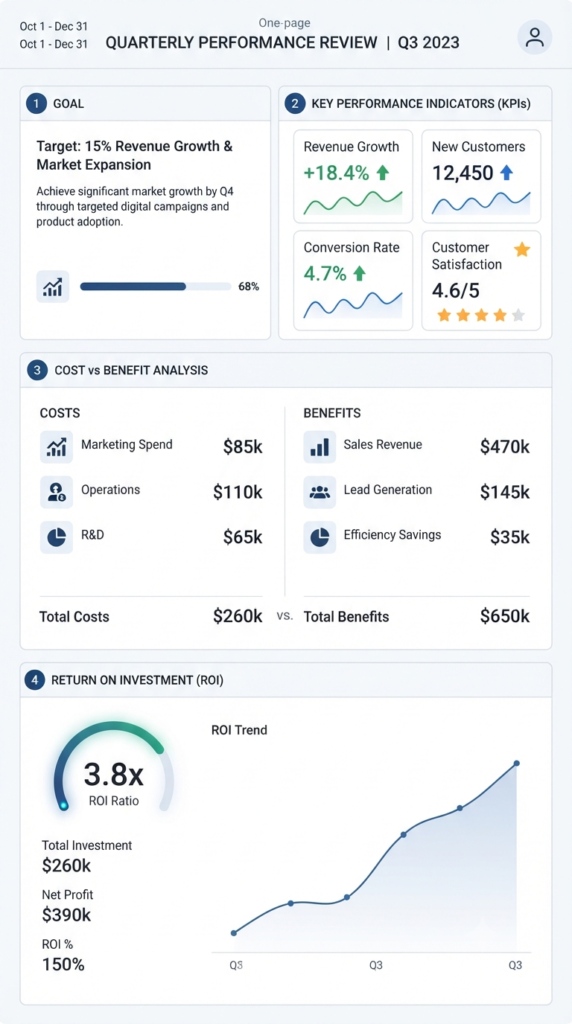
Keep it to a single page, structured like this:
- Goal — the specific business outcome you targeted.
- What we did — the AI use case, in plain language, one or two sentences.
- Key KPIs before vs. after — the actual numbers, side by side.Cost vs. benefit — total spend against total measurable benefit.
- ROI % — the single number everyone in the room will remember.
- Next steps — scale, adjust, or stop, with a brief reason.
Here’s roughly how that sounds in an actual board meeting: “We targeted a 30% reduction in support cost per ticket. Over 90 days, we cut it from $4.20 to $2.85, while keeping satisfaction above our 85% guardrail. Total cost was $50,000; total measurable benefit was $148,000 — a 196% return. Based on that, we’re recommending we scale this to two more regions next quarter.”
That’s it. No jargon, no vague optimism, no hand-waving about “the future of AI.” Just a clear, honest, numbers-first account of what happened. This is exactly the kind of communication that builds long-term credibility with boards and investors — and it’s the difference between a leader who gets more budget approved for the next initiative, and one who gets quietly sidelined the next time AI comes up.
Local and Global Reality: From Lagos to Silicon Valley
I want to be direct about something a lot of global advisors avoid saying clearly: the challenges around AI strategy are not identical everywhere, even though the underlying framework is.
Globally, in markets like the US, UK, and Western Europe, the pressure tends to come from expectation and competition — investors who’ve read every AI headline, competitors moving fast (or claiming to), and governance and compliance requirements that add real complexity to how AI can be deployed, especially around data handling.
Locally, in markets like Nigeria and much of Africa, the pressure often looks different: infrastructure limitations, smaller technology budgets, and a smaller pool of AI-specific talent to hire from. But there is also a real opportunity that’s frequently underestimated — because the operational baseline in many local businesses is manual and paper-heavy, even modest, well-targeted AI use cases can produce outsized, easily measurable improvements. A five-person team doing manual invoice reconciliation can see a dramatic time reduction from a fairly simple AI tool — a jump that’s harder to replicate in an already highly automated enterprise abroad.
The five-step framework above doesn’t change between these contexts. What changes is the scale of the numbers and the specific use case you pick.
Consider the example of RUN, a Nigerian logistics startup. The company uses an AI-driven platform to automate customer delivery-status updates and route confirmations for local businesses. By pairing them with the closest dispatch rider and aggregating deliveries, it cuts admin workload and operational waste .
For an SME, this translates into measurable results—reduced fuel consumption, faster delivery times, and better driver accountability. The ROI is measured in hours saved and orders processed per staff member, and it is provable within 60 days .
In fact, RUN has already gained over 8,400 customers and 1,900 riders in Nigeria, working with partners like Jumia and Reliance Health HMO .
Also onsider CallHippo, a global VoIP provider. The company implemented AI-driven conversation intelligence to analyze customer calls and detect dissatisfaction signals before customers decided to leave. The outcome: a 20% reduction in revenue churn and a 13% increase in new revenue .
This is not a hypothetical. It is a documented reality of what happens when AI is used to predict and prevent churn. The ROI is measured in retained revenue and improved conversion rates—and it is provable within one billing cycle.

Your Role as a Leader: Turning AI from Fear into Advantage
You don’t need to become a data scientist. You don’t need to personally understand how a transformer model works. What you do need — and what actually separates leaders who come out of this AI era stronger from those who don’t — is three things:You set clear goals before any AI conversation starts, so every initiative has something real to be measured against.
You demand measurable results, not enthusiasm, not usage statistics, not vague claims of “innovation.” Numbers or it didn’t happen.
You build a culture where AI is tied to business outcomes, not hype — where your team knows that “we launched an AI feature” is not the finish line; proving it moved a real number is.
When you do this consistently, something shifts. AI stops being the thing that keeps you up at night, wondering if you’re falling behind. It becomes one more lever you know how to pull deliberately, measure honestly, and scale confidently. That shift — from reactive fear to disciplined advantage — is available to any leader willing to follow a process instead of chasing headlines.
Conclusion:
The window to fix AI strategy failure 2026 is closing—but it isn’t closed yet.
The Next 90 Days Are Yours to DefineMost AI strategies fail in 2026 not because the technology is weak, but because they were never built to prove their own value. No clear goal. No focused use case. No baseline KPIs.
No honest cost-versus-benefit tracking. No time-boxed decision point. Fix those five things, in that order, and you fix almost everything else.
It is not too late to correct course — not for you, not for your board, not for your team. The leaders who will look back on 2026 as the year they got AI right are not the ones who moved fastest or spent the most. They’re the ones who got disciplined first.
The next 90 days can either be another wasted AI experiment quietly draining your budget — or the turning point where AI finally starts working for your business, in numbers you can defend in any boardroom, anywhere in the world.
Ready to Fix Your AI Strategy?
If this article described your reality — the scattered pilots, the pressure from your board, the nagging question of whether your AI spend is actually working — you don’t have to figure it out alone.I work directly with CEOs, founders, and leadership teams to turn unfocused AI experiments into a disciplined, provable strategy using the exact framework above, tailored to your business, your market, and your numbers. ⬇️ Book a Strategy Call to walk through your current AI initiatives and identify the fastest path to measurable ROI.
Frequently Asked Questions
Q 1: How long does it take to see ROI from AI?
With a focused use case and clear KPIs, most companies can see a measurable signal within 60 to 90 days. Full-scale, mature ROI often takes two to four quarters, but you should never wait that long to know whether something is working — the 90-day checkpoint is designed to catch that early.
Q 2: What if we don’t have much data?
Start smaller than you think you need to. Many high-impact AI use cases — scheduling automation, customer follow-ups, basic lead scoring — work with modest data and improve as they run. Don’t let “we need more data first” become an excuse to delay starting.
Q 3: Can small businesses use this framework, or is it only for big companies?
This framework is arguably more important for small businesses, because you have less room to waste budget on unfocused experiments. The steps scale down easily — a solo founder can run this in a spreadsheet in an afternoon.
Q 4: What if our first AI project fails?
Then you’ve learned something concrete and inexpensive, instead of something vague and costly a year later. A well-run pilot that misses its target still tells you exactly where to adjust — that’s success, even if it doesn’t feel like it.
Q 5: Do we need expensive tools to track AI ROI?
No. A simple spreadsheet tracking cost versus benefit against clear KPIs is enough to start. Sophisticated dashboards can come later, once you know the framework is producing real, trackable results.
Q 6: How many AI use cases should we run at once?
One or two, especially at first. Focus produces measurable results; breadth without focus produces confusion and unmeasured spend.
Q 7: How is this different from what our IT or product team is already doing?
IT and product teams typically own the technical execution of AI tools. This framework sits above that — it’s the business discipline that decides which use cases matter, what success looks like in numbers, and how results get proven to leadership. Both are necessary; this article addresses the layer that’s usually missing.