Building a robust AI-ready data foundation is the most critical step for any executive looking to scale AI in 2026.
Table of Contents
Introduction:
Picture a CEO sitting in a Monday morning review, staring at the results of an AI pilot the company launched six months earlier with real excitement. The dashboards are live. The vendor demo was impressive. But the output in front of the leadership team doesn’t match reality — the churn predictions are wrong, the sales forecasts contradict what the regional managers already know, and nobody on the team fully trusts the numbers anymore.
The CEO asks the obvious question: “What went wrong with the model?”The honest answer, in most cases, isn’t the model at all. It’s the data underneath it.
If you’re a CEO, founder, or executive who has felt this exact frustration, you’re not alone. Across boardrooms — from Lagos to London, from Nairobi to New York — leaders are discovering the same uncomfortable truth: they bought AI tools, deployed pilots, and hired consultants, but the results are inconsistent, unreliable, or simply underwhelming.
Their data is scattered across spreadsheets, aging ERPs, CRMs nobody fully updates, and — more often than leaders like to admit — WhatsApp threads and personal notebooks. And beneath the excitement about AI sits a quieter fear: what happens if sensitive company or customer data leaks through an AI tool nobody properly vetted?
Industry research consistently shows that a large share of AI pilots stall before they ever scale into production, and data issues are one of the most commonly cited reasons why. Leading consultancies report that organizations with weak data foundations see AI initiatives take longer, cost more, and deliver less value than expected.
This article gives you something different from the usual AI hype. By the end, you’ll have a clear, practical framework — the kind I use directly with CEOs and founders — for building an AI‑ready data foundation, even if your current systems are a genuine mess. No jargon. No assumption that you need a full data science team. Just a repeatable method you can start using in the next 30 days.
The Hard Truth: AI Is Only as Good as Your Data
Here’s the principle that every technology vendor’s sales pitch conveniently skips: AI models learn from data. They don’t invent judgment out of thin air — they detect patterns in whatever information you feed them.
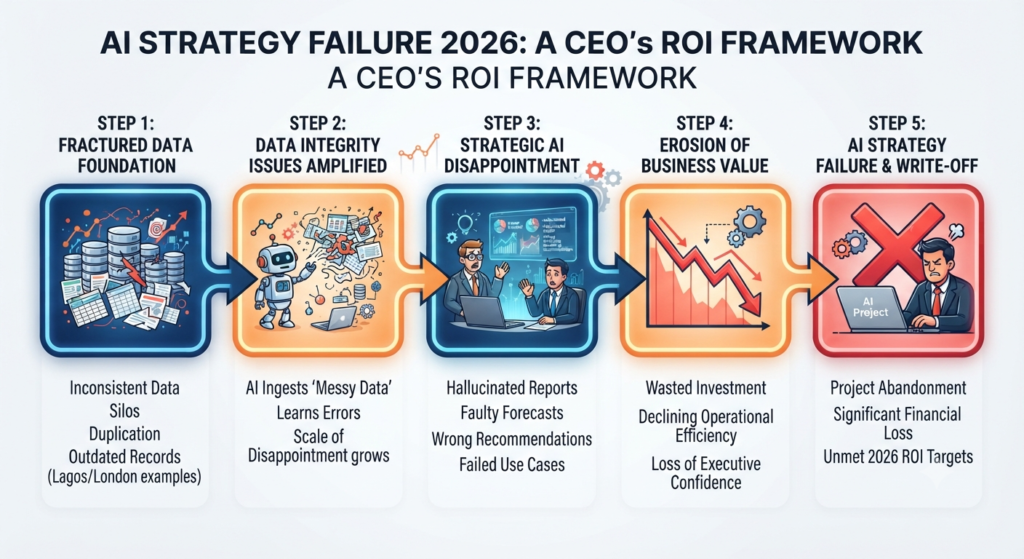
When that information is incomplete, inconsistent, duplicated, or outdated, the AI doesn’t magically correct for it. It amplifies the mess.
This is where most of the AI disappointment stories actually originate. The hallucinated report. The marketing recommendation that makes no sense. The forecast that’s wildly off.
In the vast majority of cases I’ve seen, the root cause traces back not to a flawed model, but to a fractured data foundation feeding it.
The pattern is the same whether you’re in Lagos or London. The companies that fail with AI are almost never failing because the AI is broken. They are failing because the data feeding it is broken. Data lives in silos. It is inconsistent. It is duplicated. It is incomplete. And when you feed that mess into an AI system, it does not clean it up. It simply learns from it and scales the mess.
The lesson is simple: before AI comes data. If your foundation is weak, AI doesn’t fix your problems — it exposes and magnifies them, often at a scale and speed that makes the damage more visible and more expensive.
Why Most Data Foundations Are Not AI‑Ready (Global and Local Reality)
Across the organizations I’ve worked with — enterprise and SME, global and local — the same patterns show up again and again.
Common global enterprise challenges:
- Data is siloed across departments, business units, or systems acquired through M&A, with no single source of truth.
- Significant IT budget is consumed simply keeping legacy systems alive, leaving little room for real data transformation work.
- Security and privacy anxiety — leaders are genuinely afraid of leaks, breaches, or sensitive data ending up inside a public AI tool without proper controls.Unresolved questions about intellectual property: who owns AI‑generated outputs, and is the underlying training data even legally safe to use?
Common realities in Nigeria, Africa, and other emerging markets:
- Tighter budgets mean fewer dedicated data or IT resources, so manual processes and spreadsheets fill the gap.
- Infrastructure can be patchy — inconsistent internet access, power interruptions, and limited access to enterprise‑grade tools shape how data actually gets captured and stored day to day.
- A heavier reliance on informal channels (WhatsApp, phone calls, paper records) for real customer and operational information that never makes it into a “real” system.
Example — European manufacturer: A manufacturing company in Europe, built up over decades through several acquisitions, found itself running more than 20 legacy systems with no single source of truth for basic questions like “how many units did we actually sell to this customer last quarter?”
Example — Nigerian SME: A Nigerian SME discovered that sales figures, inventory counts, and financial records lived in three different tools, maintained by three different people, none of whom reconciled their numbers with each other on any regular basis.
The shape of the problem differs by geography and company size, but the underlying issue is identical: fragmented, inconsistent data that no AI system can responsibly build on. For leadership navigating the complexities of an [AI strategy failure 2026: a CEO’s ROI framework], recognizing these foundational gaps is the first step toward building a sustainable digital future.
The Business Impact: What Bad Data Costs You
It’s tempting to treat “data quality” as a back‑office IT concern. It isn’t. It’s a direct driver of business outcomes.
- Wasted AI spend — pilots that never make it to production because the data underneath them couldn’t support real decisions.
- Slower decision‑making — leaders stop trusting the numbers, so decisions default back to gut instinct and delay.
- Higher risk exposure — compliance gaps, security vulnerabilities, and reputational risk from mishandled data.
- Missed opportunities — the AI use case that could have worked, but never got the chance because the data wasn’t ready.
Every month you delay fixing your data foundation is a month you delay real AI value — often by months or years, not days.
A CEO I know learned this the hard way. By the time they realized their customer and transaction data was too inconsistent and incomplete to support the use case they had chosen, they had already spent roughly $150,000 and six months on the initiative—until we helped him identify that the model wasn’t the failure. The foundation was.
The 5‑Step AI‑Ready Data Framework
This is the practical core of this article — the same framework I use directly with leadership teams to move from data chaos to AI‑ready in a matter of weeks, not years.
Step 1: Map Your Data Reality (Brutal Honesty)
Before you can fix anything, you need an honest inventory of where your data actually lives — not where it’s supposed to live.
- List every major data source: CRM, ERP, spreadsheets, shared drives, WhatsApp, even paper records.
- Identify which data genuinely matters for revenue, cost control, and risk management.
- Spot the duplicates, the gaps, and what I call “shadow data” — information that exists, but only in one person’s head or one person’s phone.
Simple exercise: In a single meeting, ask every department head the same question: “What data do you rely on daily, and where does it actually live?” The answers are often more revealing — and more alarming — than any formal audit.
A Lagos retailer ran this exercise and discovered that roughly 40% of what they considered “customer data” existed only in individual sales reps’ personal phones — never entered into any company system at all.
Step 2: Choose the Critical 20% (Focus on What Moves the Business)
You do not need to fix all of your data at once — and trying to will exhaust your team and stall progress entirely. Apply the 80/20 principle: focus on the roughly 20% of data that drives 80% of your business decisions and value.
- Common high‑priority data domains:Customer data — for sales and marketing AI use cases.
- Order and invoice data — for operations and finance AI use cases.
- Support tickets and FAQs — for AI‑powered customer support.
How to prioritize: Ask, for each candidate dataset, “If this data were perfect tomorrow, which business outcome would improve the most?” Start there.
Step 3: Clean and Connect the Priority Data
With your priority data identified, the real work begins:
- Define standard formats — consistent customer IDs, product codes, and naming conventions.
- Remove obvious duplicates and correct clear errors.
- Build basic connections between your key systems — even a simple, well‑built integration beats none at all.
Start small, but start. One clean, fully connected data flow is worth more than ten half‑finished data projects.
Just like A SaaS company that connected its CRM, billing system, and product usage data into a single reliable pipeline — the specific step that finally made accurate churn and upsell predictions possible.
Step 4: Set Basic Governance and Security Rules for AI
You do not need a 100‑page governance manual to start. You need a small number of clear rules that people actually follow.
Plain‑language examples:
- No customer personally identifiable information (PII) goes into free or public AI tools.
- Financial data stays within approved, secured systems only.
- AI tools are used only on datasets that have been explicitly approved.
This directly addresses the two fears leaders raise most often: security/privacy risk (leaks and breaches) and IP/legal risk (who owns AI outputs, and is the training data legally safe to use). Clarity here builds the trust your team needs to actually adopt AI with confidence.
Step 5: Build a Minimal “AI‑Ready” Data Stack and Roadmap
Identify the minimum viable tools you actually need:
- Simple dashboards tracking the KPIs that matter most. Avoid over‑engineering. A 6–12 month roadmap might look like:
- Phase 1: Critical data cleaned and connected.
- Phase 2: Governance and security rules enforced.
- Phase 3: Advanced AI use cases layered on top of the now‑solid foundation.
Example: A Nigerian SME moved from scattered spreadsheets to a simple cloud CRM integrated with basic accounting software — a modest step that became the entire foundation for their AI‑driven sales and finance initiatives.
Real Stories: From Data Chaos to AI‑Ready (Local & Global)
A global enterprise: After years of fragmented customer and product data slowing every AI initiative, one enterprise focused a dedicated effort on cleaning and connecting just its core customer and product datasets. The result: AI project timelines dropped by roughly half, because teams no longer had to fight the data before they could even begin modeling.
A Lagos e‑commerce brand: By centralizing order and customer data into a single, consistent source, this brand cut administrative overhead by close to 30% and saw a meaningful improvement in the relevance — and therefore the ROI — of its AI‑driven marketing.
A mid‑size services firm: After struggling for over a year to launch a reliable AI‑powered support assistant, the firm finally succeeded once it invested in cleaning and properly structuring its support ticket history and internal knowledge base. The assistant that had repeatedly failed on messy data became genuinely useful almost immediately once the foundation was fixed.

How This Connects to Your Overall AI Strategy
In our guide “Why Most AI Strategies Fail in 2026, (AI Strategy Failure 2026: A CEO’s 5-Step ROI Framework ),” we covered how to tie AI initiatives directly to business goals and measure real ROI using a structured framework. This article is the foundation layer underneath that strategy: without AI‑ready data, even the best‑designed AI strategy will struggle to deliver, or fail outright.
Your Role as a Leader: Owning the Data Foundation
You don’t need to become a data engineer. But as the leader, you do need to:
- Demand clarity on exactly where your organization’s key data lives today.
- Insist on basic governance and security rules before any AI tool touches sensitive information.
- Champion incremental, focused progress over the pursuit of a “perfect” data system that never arrives.
Be the leader who says, clearly and without apology: “No more AI experiments on broken data.” Then champion a focused 90‑day sprint to bring your most critical data up to AI‑ready standard.
Conclusion
AI cannot fix a broken data foundation — no matter how sophisticated the model or how large the budget behind it. The organizations that win in 2026 will be the ones that treat data as strategic infrastructure, not an afterthought bolted on after the AI tools are already purchased.
You don’t need to fix everything at once. Start with the critical 20%, set a small number of clear rules, and build outward from there.
The next 90 days can either be another wasted AI pilot — or the turning point where your data finally becomes an asset, not a liability.
Ready to Build Your AI‑Ready Foundation?
If this article resonated with where your organization stands today, the next step is a focused conversation, not another tool purchase.
- Book a Data & AI Readiness Audit to get a clear picture of exactly where your data stands and what to fix first. Email me at ⬇️ info@digitalsuccesshub.org
Frequently Asked Questions
Q 1: How do we know if our data is “AI‑ready”?
Your data is generally AI‑ready when it’s accurate, consistent, accessible from a central source, and governed by clear rules about who can use it and how. If you can’t confidently answer basic questions about a customer or transaction without cross‑checking three different systems, you’re not there yet — and that’s completely normal as a starting point, not a failure.
Q 2: What if we don’t have much data yet?
That’s actually an advantage. Smaller data volumes are easier to clean and structure correctly from the start, and you can build good habits — consistent formats, single sources of truth — before the data grows large enough to make cleanup painful.
Q 3:Can small businesses use this framework, or is it only for big companies?
The framework was built to scale down as easily as it scales up. A small business might complete Steps 1 through 3 in a matter of weeks using a spreadsheet and a single shared CRM, while a large enterprise applies the same logic across dozens of systems. The principles don’t change — only the scope does.
Q 5: What if our first AI project fails because of bad data?
Treat it as diagnostic information, not a dead end. A failed AI pilot almost always reveals exactly which data gaps need fixing first. Many of the strongest AI‑ready organizations I’ve worked with started with a failed pilot that told them precisely where to focus.
Q 6: Do we need expensive tools to build an AI‑ready data foundation?
No. Most organizations can make significant progress with tools they already own or affordable additions — a cloud CRM, a basic integration tool, and clear internal rules. The constraint is rarely budget; it’s usually clarity and follow‑through.
Q 7: How long does it typically take to become AI‑ready?
For the critical 20% of your data, meaningful progress is achievable within a focused 90‑day sprint. Full organizational data maturity is an ongoing process, but you don’t need to wait for full maturity before AI starts delivering real value on your priority use cases.
Q 8: What are the biggest data mistakes CEOs make with AI?
The most common mistake is buying AI tools before addressing the underlying data foundation, followed closely by trying to fix all data at once instead of prioritizing the critical 20%. A close third is skipping governance entirely until after a security scare forces the issue.
Q 9: Should we hire a data team before starting on AI?
Not necessarily, and not immediately. Many organizations make real progress using existing staff, clear ownership, and the right lightweight tools before ever hiring dedicated data specialists. Bring in specialized expertise once your use cases and priorities are clear enough to justify the investment.