
Table of Contents
Most companies are using AI to save money. The leaders who will define the next decade are using it to make money — and the gap between those two groups is quietly becoming the biggest competitive divide in business today.
If you’re a CEO or founder and your AI conversation has been dominated by headcount reduction, automation, and “efficiency,” you’re not wrong to care about those things. But you’re solving the wrong problem. The real question isn’t how AI can help you spend less. It’s how CEOs can use AI for revenue growth, not just cost cutting — and that question is where the next generation of market leaders will be separated from everyone else.
This article is built around a real transformation — Reckitt’s revenue growth management overhaul — and it exists to give you a working playbook, not a motivational essay.
Why Most Companies Miss the Point
Walk into almost any boardroom discussing AI strategy right now, and the conversation follows a predictable script. Someone presents a case for automating customer service. Someone else pitches AI for back-office efficiency — invoice processing, HR ticketing, scheduling. Finance loves it because the ROI story is simple: fewer people, lower costs, cleaner margins on a slide.
This isn’t a bad instinct. Cost discipline matters, especially in a world of tighter margins, inflationary pressure, and investor scrutiny. It fits into a broader AI strategy for CEOs and founders navigating volatility — but cost discipline alone isn’t a growth strategy. But it’s an incomplete strategy, and here’s the uncomfortable truth: cost-cutting AI has a ceiling. You can only shrink your way to so much value. At some point, the efficiency gains flatten out, the easy automations are done, and the organization has optimized itself into a smaller version of what it already was. Revenue is different. Revenue has no ceiling. And that’s precisely why the CEOs who treat AI as a growth engine — not just an expense-reduction. tool — end up building compounding advantages that cost-focused competitors can’t catch up to.
There’s also a structural reason so many organizations default to cost-cutting: it’s easier to measure, easier to sell internally, and easier to justify to a board in one sentence. “We reduced processing time by 40%” is a clean story. “We changed how our commercial teams make pricing and promotion decisions across 95% of our revenue base” is a much bigger story — but it requires more courage, more cross-functional coordination, and more patience to build.
Most leadership teams take the easier path not because it’s smarter, but because it’s more comfortable.That comfort is expensive. While competitors trim costs, the companies who commit to AI-powered revenue growth are rebuilding how they decide what to sell, to whom, at what price, and through which channel — and that’s a different order of transformation entirely.
What Reckitt Did Differently
Reckitt — the global consumer health and hygiene company behind brands like Lysol, Dettol, Durex, and Mucinex — didn’t start with a chatbot pilot or a customer service automation project. It went straight at the commercial engine of the business: Revenue Growth Management, or RGM.

For years, Reckitt’s approach to RGM had been largely reactive. Pricing and promotion decisions were often made in silos across fragmented technology, inconsistent across markets, and heavily reliant on individual judgment. If that sentence sounds familiar, it’s because it describes how most large organizations still operate today — including, quite possibly, yours.
Regional teams making pricing calls based on instinct and spreadsheets. Promotional decisions that vary wildly by market, with no shared intelligence layer connecting them. Judgment calls standing in for data-driven precision, simply because nothing better existed. Facing margin pressure, inflation, and intensifying competition, Reckitt’s leadership decided the answer wasn’t to trim costs around the edges of that system — it was to rebuild the system itself, powered by AI.
The company set out to become predictive, proactive, and fast rather than reactive, embedding AI deeply into its commercial planning process.The scale of what they did is the part CEOs should sit with. This wasn’t a pilot in one market or a proof-of-concept dashboard shown to the board once and forgotten.
Reckitt trained 750 colleagues directly in revenue growth management, building AI-powered predictive commercial planning capability that ultimately covered 95% of the company’s net revenue. That kind of scale doesn’t happen by accident — it requires building an AI-ready team from the ground up, not just deploying a tool and hoping people adapt. The result: more than $500 million in revenue gains directly tied to the RGM transformation.
Why does this matter so much for CEOs? Because it proves something most AI vendors won’t tell you: the biggest AI wins aren’t found in isolated tools bolted onto existing processes. They’re found in changing how the core commercial decisions of the business get made — pricing, promotion, mix, and allocation — at a scale broad enough to move the entire net revenue line. Reckitt didn’t ask AI to do a job faster. It asked AI to help hundreds of people make better decisions, consistently, across nearly the entire business.
That’s the model. Not “AI did the work instead of a person.” Instead: “AI helped 750 people make decisions they were previously making with fragmented data and gut instinct — and those better decisions added up to half a billion dollars.”
Why AI for Revenue Growth Is Different from Cost-Cutting AI
It helps to be explicit about what actually separates these two approaches, because on the surface, both get pitched using the same buzzwords — “AI transformation,” “digital enablement,” “data-driven.” The substance underneath is where they diverge.
Reactive planning vs. predictive planning. Cost-cutting AI typically automates a task that already exists — it takes a known, repeatable process and does it faster or cheaper. Revenue growth AI, by contrast, is forward-looking. It’s asking: given current demand signals, competitor moves, market conditions, and historical response patterns, what pricing or promotion decision should we make next — before the window to act closes? Reckitt’s shift from reactive to predictive RGM is the clearest illustration of this. The company stopped waiting to react to margin erosion and started anticipating it.
Automation vs. decision improvement. Automation replaces a human doing a task. Decision improvement gives a human better information to make a judgment call they were always going to make anyway — just with less guesswork. A pricing analyst who used to set promotional discounts based on last year’s playbook and instinct now sees a model-generated recommendation grounded in elasticity data, competitive pricing signals, and channel-level performance. The human still decides. But the decision is sharper.
Savings vs. growth. This is the most important distinction for a CEO’s mental model. Cost savings show up once and then plateau — you can only cut a given expense line so far before you hit diminishing returns or damage the business. Revenue growth compounds. Better pricing decisions this quarter set a better baseline for next quarter. Better mix decisions this year change what “normal” looks like next year. Growth-oriented AI investment builds a flywheel; cost-oriented AI investment builds a smaller version of the same machine.
Isolated tools vs. commercial transformation. A chatbot here, an automated report there — these are point solutions. They help, but they don’t change how the business thinks. What Reckitt built was closer to a new operating layer for commercial decision-making, embedded across markets and touching the vast majority of net revenue. That’s the difference between deploying a tool and transforming a function.
If you remember nothing else from this section, remember this: cost-cutting AI asks “how do we do the same thing for less?” Revenue growth AI asks “how do we make a fundamentally better decision than we could before?” Only one of those questions has an upper limit.
The CEO Playbook: A Step-by-Step Framework
This is the part that matters most, because insight without a framework is just an interesting read. Here is a practical, sequential approach you can start using immediately — whether you run a 40-person company in Lagos, a 4,000-person enterprise in London, or a fast-scaling startup anywhere in between.
Step 1: Audit where revenue decisions actually get made
Before you touch a single AI tool, map out the real decision points in your commercial engine. Where does pricing get set? Who decides on promotions, and based on what information? How is your product or service mix decided across regions or customer segments? Where does your sales team lose deals — and why? Most CEOs assume they know the answers. Very few have actually mapped it. This audit alone often reveals more waste and missed opportunity than any cost-cutting exercise would.
Be honest about where judgment is standing in for data. That gap — wherever a smart, experienced person is making a high-stakes call with incomplete information — is your highest-value AI opportunity. It was Reckitt’s starting point too.
Step 2: Identify your highest-leverage revenue decisions
Not every decision deserves AI investment. Rank your commercial decisions by two factors: frequency (how often is this decision made?) and financial weight (how much revenue or margin does each decision touch?). A pricing decision made weekly across every SKU in every market is high-frequency and high-weight — a prime candidate. A once-a-year strategic pivot is high-weight but low-frequency, and usually better suited to human judgment supported by analysis rather than a live AI system.
Step 3: Involve the right teams from day one
This is where most AI initiatives quietly fail. CEOs hand the mandate to IT or a data science team in isolation, and the resulting tool doesn’t reflect how commercial decisions actually get made on the ground.
Revenue growth AI has to be co-built with the people who own the outcome: sales leadership, commercial finance, category or brand management, and regional operators who understand local market nuance. Reckitt’s transformation touched 750 people precisely because revenue growth management isn’t a back-office function — it’s distributed across the organization, and the AI capability has to be distributed with it.
Step 4: Choose your first use case deliberately
Pick one commercial decision area — pricing elasticity modeling, promotional effectiveness, demand forecasting, or channel mix optimization are common starting points — and go deep rather than wide. The instinct to roll out AI everywhere at once is understandable, but it’s also how most transformations collapse under their own complexity. Prove the model in one area with clean data and clear ownership before you scale it.
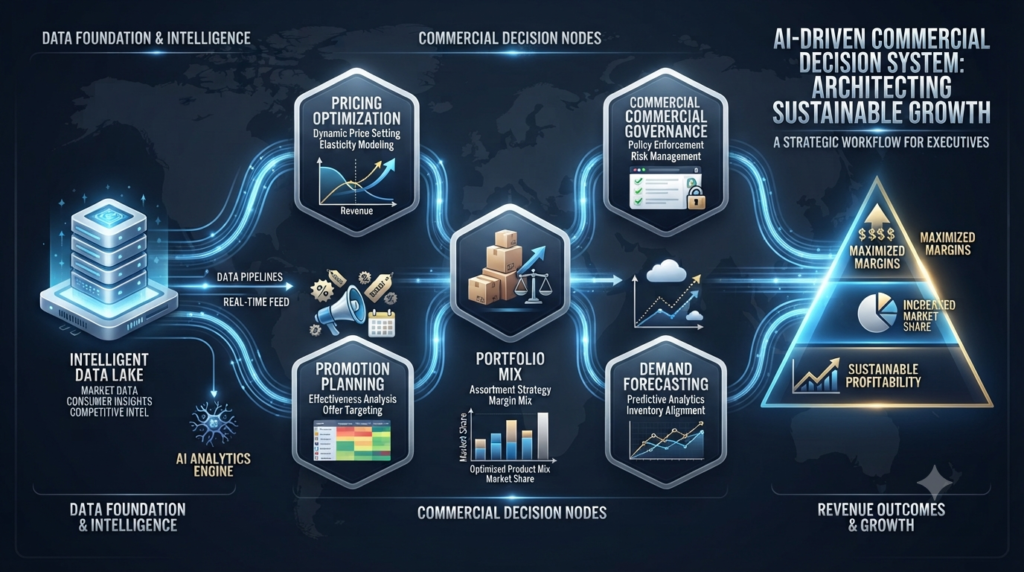
Step 5: Define what “impact” actually means before you start
Decide, in advance, exactly how you’ll measure success. Revenue lift attributable to the AI-informed decision versus a control group. Margin impact. Speed of decision-making. Adoption rate among the teams who are supposed to be using it. If you wait until after deployment to figure out how you’ll measure impact, you’ll get vague, unconvincing results — and an initiative that’s easy for skeptics to kill.
Step 6: Scale responsibly, not aggressively
Once you have proof in one market or one product line, expand deliberately — new region by new region, team by team — rather than declaring victory and mandating adoption everywhere overnight. Reckitt’s path to 95% net revenue coverage wasn’t a single big-bang rollout; it was a scaled expansion built on demonstrated results. Responsible scaling also means continuously retraining your models and your people as market conditions shift — this is not a “build it once” initiative.
What to Do in the First 30, 60, and 90 Days
CEOs don’t need another five-year AI roadmap. You need to know what to do this quarter.
Days 1–30: Diagnose your revenue decision bottlenecks. Spend this month understanding, not building. Interview your commercial, sales, and finance leaders about where pricing, promotion, and mix decisions get made — and where those decisions are slow, inconsistent, or based on incomplete data. Pull together whatever data already exists on past pricing and promotional performance, even if it’s messy. By day 30, you should have a clear, written picture of your three to five highest-leverage revenue decision points and an honest assessment of your data readiness in each.
Days 31–60: Pilot one high-value use case. Choose the single decision area with the clearest data, the most engaged team, and the most measurable outcome. Build or deploy a focused AI capability there — not a company-wide platform. Assign a clear owner, ideally a commercial leader rather than a purely technical one, since adoption depends on the people using the tool trusting and understanding it. By day 60, the pilot should be live and generating real recommendations that your team is actually using in day-to-day decisions.
Days 61–90: Measure, refine, and expand. Compare outcomes against your pre-defined success metrics. Where did the AI-informed decisions outperform the old process, and by how much? Where did the model get it wrong, and why? Use this quarter to refine the approach based on real evidence, and start drafting your expansion plan for the next market, product line, or decision type. By day 90, you should have a data-backed business case — not a hopeful projection — to bring to your board or leadership team for continued investment.
Advantages and Disadvantages — An Honest Account
Any CEO who’s been in business long enough knows to be suspicious of a perfectly one-sided pitch. So here’s the balanced picture.
The genuine advantages: AI-powered revenue growth management gives you decision consistency across a large organization — the same quality of pricing logic in every market, not just the ones with your best analysts. It compounds over time rather than plateauing, because better decisions this quarter improve the baseline for every quarter after.
It surfaces patterns humans genuinely can’t see at scale — cross-market elasticity effects, subtle promotional cannibalization, demand signals buried in noisy data. And it builds organizational capability, not just output: when you train hundreds of people to work alongside these tools, you’re building a commercially sharper workforce, not just a faster process.
The real risks: Weak data is the single biggest killer of these initiatives. If your historical pricing, sales, and promotional data is inconsistent, siloed, or simply doesn’t exist in usable form, no model will produce reliable recommendations. “This is exactly why building an AI-ready data foundation has to come before any predictive model — no algorithm can fix data that was never structured to be trusted.” Garbage in, garbage out remains as true with AI as it ever was with a spreadsheet.
Bad adoption is the second-biggest risk. A brilliant model that commercial teams don’t trust or don’t understand is a wasted investment. If your teams feel the AI is replacing their judgment rather than sharpening it, you’ll get quiet resistance, workarounds, and eventually abandonment.
Overpromising is a trap CEOs set for themselves. Vendors and even internal champions will sometimes present AI-driven revenue growth as near-automatic. It isn’t. Reckitt’s results came from training 750 people and rebuilding a process across nearly the entire company — that’s sustained organizational effort, not a switch you flip.
Governance gaps are the quiet danger. Pricing and promotional decisions carry regulatory and competitive sensitivity in many markets. Without clear governance — who can override a model’s recommendation, how pricing fairness is monitored, how compliance is maintained across jurisdictions — you’re exposed to risks that go well beyond a bad quarter. These are the same blind spots behind the AI accountability gap most CEOs don’t see coming until it’s expensive.”
And finally, wrong assumptions can undermine the whole effort before it starts. Assuming your market behaves like your headquarters market.
Assuming last year’s elasticity holds this year. Assuming a model trained on aggregate data understands the nuance of a specific customer segment. These assumptions need to be tested continuously, not set once and forgotten.
What Most CEOs Should Realistically Expect
Let’s be direct about realism, because false expectations kill more AI initiatives than bad technology does.
What’s realistic: Meaningful, measurable revenue and margin improvement in the specific decision areas where you deploy AI well — typically in the mid-single to low-double-digit percentage range on the metrics you’re targeting, depending on how reactive and fragmented your starting point was. The more disorganized your current commercial decision-making, the larger your realistic upside, simply because you’re starting from a lower baseline.
What’s possible, with sustained commitment: Results at the scale Reckitt achieved — hundreds of millions in revenue gains and near-total coverage of your net revenue base — are possible, but they require multi-year commitment, cross-functional buy-in, and a willingness to retrain and rebuild your commercial processes, not just bolt on a tool. This is a transformation, not a project.
What’s unlikely: Overnight results, a “set it and forget it” system, or revenue growth from AI that requires no change in how your teams operate. If a vendor or consultant tells you that you can achieve Reckitt-scale results with a six-week engagement and no organizational change, that’s a claim worth being skeptical of. That kind of overpromising is precisely how AI strategy failure happens — and why a disciplined ROI framework matters more than a flashy pitch.
The honest expectation to set with your board: this is a capability-building exercise with a genuine, growing financial return — not a quick win.
Conclusion: The Real Leadership Takeaway
AI is not just a tool for reducing headcount or saving time, and treating it that way is the single most expensive mistake a CEO can make with this technology right now. Used correctly, AI can help you redesign how revenue decisions actually get made across your organization — how you price, how you promote, how you allocate resources toward growth — and in doing so, unlock a category of value that cost-cutting alone can never reach.
The companies that will lead their industries over the next decade won’t be the ones who used AI to become slightly leaner. They’ll be the ones who used it to become fundamentally sharper decision-makers, at scale, across every market they operate in.
Reckitt trained 750 people and rebuilt its revenue growth management around AI-powered prediction — and turned that into more than half a billion dollars in gains across nearly its entire net revenue base. That’s not a story about technology. It’s a story about leadership willing to point AI at growth instead of just cost.
The question in front of you now isn’t whether AI can help your business. It’s whether you’re going to keep pointing it at your expense line while your competitors point it at your revenue line.
Ready to build your own revenue growth AI strategy? If you’re a CEO or founder looking to move beyond cost-cutting and build a serious, structured approach to AI-driven revenue growth, reach out to discuss a strategic consultation: info@digitalsuccesshub.org