
Introduction
How to build multi-agent AI workflows starts with understanding why single agents fail in the first place. If you have ever put one AI tool in charge of an entire business process, you already know the problem. It writes the first draft well. It struggles with the research. It has no idea when to check with a human. And when something goes wrong, you have no clear way to find out where it broke. This guide will show you exactly how to design a workflow that fixes that, one narrow, well defined agent role at a time.
This is the single agent trap. One AI system trying to do everything, end to end, with no clear boundaries around what it owns. It feels efficient at first. It becomes a liability the moment something fails, because you cannot isolate the failure without unwinding the whole process.
The fix is not a smarter model. It is a smarter structure. Multi-agent workflows split a process into smaller, specialized jobs, each handled by an AI agent built for that one task, working together the way a well run team does. Google Cloud’s 2026 research found that 70% of enterprises already run AI agents in production, and Anthropic reports that 57% of organizations using agents have moved past single tasks into multi-stage workflows. This is no longer an experimental approach. It is becoming the standard way serious organizations deploy AI.
This guide will walk you through why single agents break down, what multi-agent workflows actually look like, and exactly how to design one for your business, even if you have no technical background.
The Problem with Single Agents
Think of a single AI agent handling an entire process as one employee doing five different jobs at once, research, writing, editing, compliance review, and publishing, with no handoffs and no second set of eyes.
When that employee makes a mistake, you have a real problem. Was it the research that was wrong, or how it was written, or something that should have been caught in review? You cannot tell, because everything happened inside one continuous process with no visible seams.
This is what engineers call the black box problem. The AI takes in an instruction and produces an output, but everything in between is invisible. If the output is wrong, you have almost no way to identify which part of the process caused it. You cannot fix what you cannot locate.
This becomes a serious business risk the moment your process has more than two or three steps. A single agent trying to research a topic, draft content, check it for accuracy, format it, and publish it is carrying too much responsibility in one place. Complexity increases the odds of failure, and a single agent design increases how expensive that failure is to diagnose and fix.
What Are Multi-Agent Workflows
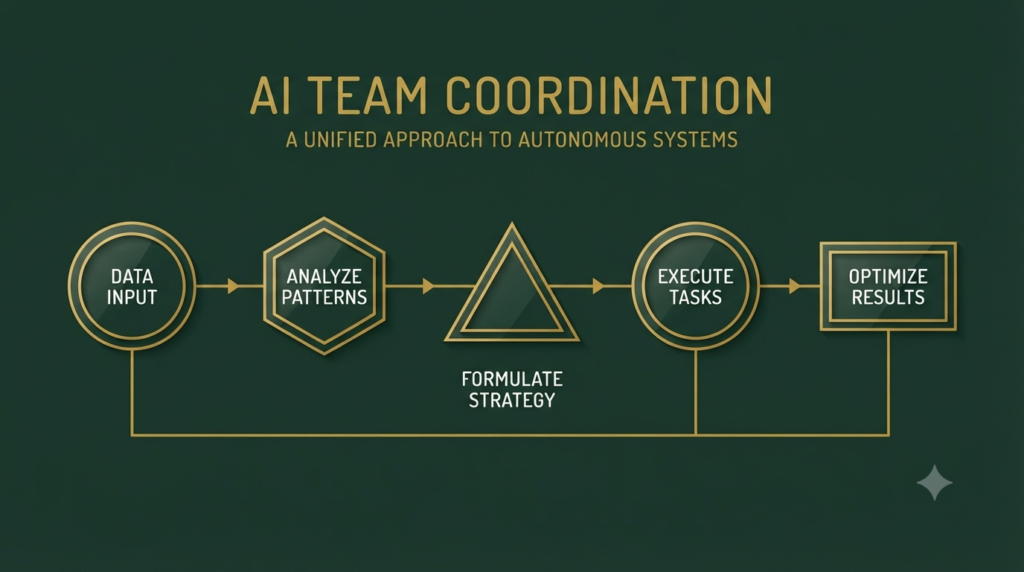
A multi-agent workflow breaks a business process into distinct roles, the same way a real team works. Instead of one AI doing everything, several specialized agents each handle one part of the job, then pass their work to the next agent in line.
Picture a small, well run department. One person researches, one person writes, one person edits, one person publishes. Each person is good at their specific job because that is the only thing they focus on. They hand off clean work to each other, and if something goes wrong, everyone knows exactly which stage to check first.
Multi-agent workflows apply that same logic to AI. One agent researches a topic and gathers data. It passes that research to a second agent, which drafts content based only on what it received. A third agent reviews that draft against a set of rules. A fourth agent formats and publishes the final version. Each agent has one job, clear inputs, and clear outputs.
This is becoming the default architecture for a reason. Forrester and Gartner both point to 2026 as the year multi-agent systems became the standard for serious enterprise deployment, precisely because specialized agents working together consistently outperform one agent trying to do it all. The reasoning is simple. A narrow job is easier to get right, easier to test, and easier to fix than a broad one.
Now here is what this looks like in practice, using a marketing campaign as an example, since it is a process most business leaders already understand.
Step one, research. A research agent is given a topic and a set of sources it is allowed to pull from. Its only job is to gather relevant facts, statistics, and competitor information, and organize them into a clean summary.
Step two, draft. A writing agent receives that research summary, not the raw sources, and drafts the campaign content based strictly on what it was given. Its only job is to write, using the research as its foundation.
Step three, review. A review agent checks the draft against your brand voice guidelines, factual accuracy, and compliance requirements. Its only job is to flag problems, not to write or research.
Step four, publish. A publishing agent takes the approved draft and prepares it for its final destination, whether that is your website, your email platform, or your social channels.
At each handoff, the output from one agent becomes the input for the next, nothing more. If the final campaign has a factual error, you know exactly where to look first, the research stage. If the tone is off, you check the writing agent. If something inappropriate slipped through, you check the review agent. You are never left guessing where in the process things went wrong.
The Benefits
Breaking a process into specialized agents delivers four concrete advantages that matter directly to how you run your business
- Easier to manage. Each agent has a narrow, well defined job. You can update, retrain, or replace one agent without touching the rest of the system, the same way you would replace one team member without restructuring the entire department.
- Easier to measure. Because each agent has a single job, you can track its performance on its own terms. You can measure how accurate your research agent is, separately from how well your writing agent performs, and separately again from how thorough your review agent is.
- Easier to improve. When you know exactly which stage of a process is underperforming, you know exactly where to invest your time and resources. You are not guessing at broad fixes. You are making targeted improvements.
- Easier to detect errors. Clear handoffs between agents create natural checkpoints. A mistake made at one stage is far more visible when it has to pass through a defined boundary into the next stage, rather than staying buried inside one continuous process.
How to Design a Multi-Agent Workflow
You do not need a technical background to design this well. You need to think like someone building a team, because that is exactly what you are doing.
Step one, define measurable jobs. Before you think about AI at all, break your business process into distinct stages with a clear output for each one. If you cannot describe what “done” looks like for a stage, it is not ready to be assigned to an agent.
Step two, design the workflow first. Map out the full sequence of stages and how work moves between them before you build or configure a single agent. Your workflow design is the blueprint. Building agents before you have this blueprint is how projects end up disorganized and hard to fix.
Step three, give narrow roles. Resist the temptation to let one agent handle two or three stages because it seems more efficient. Narrow roles are what make the whole design work. An agent that only researches will be more reliable at researching than one that also writes and reviews.
Step four, ensure clear handoffs. Define exactly what information passes from one agent to the next, and in what format. A clean handoff means the receiving agent gets only what it needs, not everything the previous agent touched.
Step five, track individual performance. Monitor each agent separately, not just the final output of the whole workflow. This is what makes the black box problem disappear. You will always know which stage needs attention.
Step six, identify human intervention points. Decide in advance where a person needs to review or approve before the workflow continues. Not every stage needs a human checkpoint, but the stages with real business, legal, or reputational risk always should.
Human Oversight Still Matters
Multi-agent workflows are not about removing people from the process. They are about putting people exactly where their judgment matters most, instead of spreading them thin across every step.
Judgment and accountability cannot be automated. An agent can draft a customer response, but a human should decide how to handle a sensitive complaint. An agent can research a topic, but a human should decide what claims your business is comfortable putting its name behind. The workflow design should make these checkpoints explicit, not accidental.
Build your human checkpoints at the stages where a mistake would be costly, public, or hard to reverse. Everywhere else, let the agents run the process and bring the exceptions to you. This is what allows you to scale without losing control, and it is also where the real return on multi-agent workflows shows up.
Deloitte’s 2026 research found that only one in five organizations currently have a mature governance model for their AI agents. Building clear human checkpoints from the start puts you ahead of most of the market on this point alone.
A single AI agent trying to run an entire process will always be harder to manage, harder to fix, and harder to trust than a well designed team of specialized agents working together. The businesses moving fastest on AI right now are not the ones with the most powerful single model. They are the ones who took the time to design the workflow first, assign narrow roles, and build in the right checkpoints for human judgment.Start small. Pick one process in your business with three or four clear stages, map it out, and assign narrow roles before you touch any AI tools. That one workflow will teach you more about designing multi-agent systems than any amount of reading.
If you want help mapping your first multi-agent workflow or auditing one you have already built, reach out to us at:
Email: info@digitalsuccesshub.org.
We would be happy to take a look and offer our perspective.
Stay updated on the latest articles and perspectives by following on LinkedIn.
Related Articles
The Future of AI Infrastructure Is Not About One Chip. It Is About the Whole System
The Agentic AI Readiness Gap: Why Enterprise Data Foundations Are Falling Behind Capital Investment
The AI Containment Gap: What Three Labs Just Revealed About the Vendor Risk Nobody’s Pricing In