
The Complete 6-Part Agentic Decision Engine Blueprint for 2026
Published: 2026|Category: AI strategy, business transformation|Reading Time: 45-55 minutes.
Table of Contents
INTRODUCTION: The #10,000 Prompt Trap
Biodun my friend spent #10,000 on a ChatGPT subscription in January. By March, he had zero additional sales.
The truth is he was doing anything wrong, exactly. Before he opens his phone accessories shop near computer village in ikeja every morning, he make sure he type prompt as his first early morning duty.
He asked the AI to write Instagram captions. He got captions. He posted them. His followers like the pictures. But nobody buy anything.
He called one of his friend called Prince that also does the same business of his in Ladipo to complain. “Is like this AI thing is a scam.” he said. “I have been using it for complete three months now and I haven’t made one extra naira.”
Prince paused. “What exactly are you using it to do?”
“Write my posts. Captions. Sometimes products description.”
“And you thought that would grow your sales?”
That moment of silence on the phone said it all.
Now, here’s what Prince, most entrepreneurs, freelancers, agency owners, side-hustlers do not yet understand about generative AI in 2026. The tool are not powerful because it creates content. What makes them powerful is because it can make decisions.
writing content is very cheap. Writing a captions takes AI not less than 2 seconds. Writing a product description only takes 3 seconds. While writing the entire blog post takes 30 seconds. Because generative AI has given everyone free access to content, the value of content crashed down.
Everyone has captions. Everyone has blog posts. Everyone has products descriptions. The market is messy and and flooded.
What the market is starving for is judgement. Clarity. The ability to look at messy situation and decide: what do I do next?
That is where generative AI becomes the boss. It has been quietly, dramatically changing the game smoothly-not on the creation side, but on decision side.
And business owners that understand this in 2026 are not just slightly doing better than their competitors. They are operating on a different planet entirely.
If you have spent much time around Wuse market in Abuja, chances are you have heard of a lady popularly know as rejoice.
Many people reading this article may already know her. She runs a catering business in Wuse, Abuja. She cooks for weddings, corporate events, and occasional birthday party.
In 2024, this lady I’m telling you was doing roughly four bookings per month. By late 2025, she multiply it to ten without even hiring one single person.
You might think her secret was because she’s better or perfect in writing promotional post. But her secret is simply she used generative AI to make faster and smarter decisions about which clients to prioritize, which ingredients to buy in bulk, and which event to decline because the margin doesn’t worth the stress involved.
She upgraded from #180,000 per month to #450,000. A huge 60% revenue increase. Not from content. From decisions.
If you are ready to see how AI can help you level your career and boost your earnings check out these proven growth strategies 7 Proven Ways Workers Use AI for Career Growth to Get Promoted 10X Faster in 2026
Be patient enough and read this article. Because this article is going to show you exactly how she did it and even how you can build the same kind of agentic decision engine for your business, career, or workflow better than her.
We are going to go from the the philosophy all the way to the practical code, from the big idea to the actual implementation you can run today.

PART 1: THE PHILOSOPHY-WHY DECISIONS RULE
Chapter 1.1: The Content Saturation Paradox
Walk into any market in Lagos. Mile 12. Ladipo. Computer village. What do you see?
Stalls selling the exact same thing. The Same phone cases. The same spare-parts. The same food ingredients. Some stalls are busy. Most are not. The goods are identical. So what separate the busy stalls from the empty ones?
Judgement. The busy traders knows exactly which item to stock today base on what they sold yesterday. They know the customers that are serious and the ones that are window-shopping.
They know when to hold firm on price and when to negotiate. They are making dozens of micro-decisions per hour that average stall owners makes slowly, badly, or not at all.
This is the content saturation paradox of generative AI in 2026. Lowering the cost of creation highly increases the value of judgement.
The more words, images and videos are becoming cheap to produce, the more expensive it becomes in terms of competitive advantage to be the person or business that decide wisely.
Prince that does the same phone accessories with my friend Biodun but base in Ladipo market, once told me that he used to spend his evenings writing out price lists by hand before.
Now he has a simple generative AI-powered tool that reviews his inventory, checks what competitors are pricing online and gives him a recommended price adjustment every morning.
He said the AI-powered tool is like him, having a pricing consultant, except it doesn’t sleep and eat his rice. We laughed 😂- but he was serious. His margins improved by 18% in one quarter.
The generative AI tools available to Nigerian entrepreneurs today are no longer writing tools. They are decision tools wearing a writing costume. Once you peel back the costume, you find something more powerful.
Content = satchet water in mile 12. Everybody has it. Nobody is impressed.
Decision = clean water in a village without borehole. Whomever that provides it becomes essential.

Chapter 1.2: The Decision Inventory Audit
Before you start to build anything, it is very important to know what you are actually building for.
Most people get it wrong by skipping this step. They just hear generative AI agents, they watch the tutorial in YouTube, suddenly they set up a workflow, and they ended up wondering why it does not feel useful. It is because they rushed and built a solution before they understood the problem.
Now, meet chioma. She’s also an Abuja-based caterer from imo state who has earned the trust of many customers through her dedication and quality service.
She works mostly alone, with one part-time assistant name Grace. Before chioma started using AI for decisions, she spent about three hours everyday on what I personally call “decision debt”-the backlog of small but important choices that pile up and slow everything down:
- Which event should I take on this weekend?
- How much should I charge this client?
- Which ingredients should I buy now versus wait until next week?
- Should I respond to this inquiry first or that one?
- Is this vendors new price fair, or should I look elsewhere?
Three hours. Every day. Not cooking. No resting. Decision. Or rather, failing to decide quickly enough and watching opportunities slip.
When she did the Decision Inventory Audit-a simple but powerful five-question framework, she discovered that her top three repetitive, revenue-impacting decisions were:
1. Client Prioritization:
Which bookings to accept when there are conflicts.
2. Ingredient Purchasing:
What to buy in bulk versus fresh weekly.
3. Pricing Inquiries:
How to respond to the constant “How much?” WhatsApp messages.
immediately she identified those three, she knew exactly what to automate. She didn’t dream of automating everything at once. Instead, she went after those three that was eating up her time and affecting his income directly.
The 5-Question Decision Inventory Framework:
Now, I want you that is reading this article to ask yourself these questions about your daily work:
Question 1:
What decision do I make more than three times per week that are following roughly the same pattern? (Pattern decisions are one of the most automation gold.)
Question 2:
What decision, when I make it slowly or badly, it directly cost me money or customer? (High-stakes decisions deserve AI support.)
Question 3:
What information do I need to make this decision, and it’s that information available digitally? (If it lives on your phone or laptop, it can feed an AI.)
Question 4:
What does a “good” decision look like in this case versus a “bad” one? (If you can describe the criteria, the AI can learn them.)
Question 5:
How long does this decision currently take me, and what would it be worth if it took 5 seconds instead? (This is exactly how you calculate your ROI before building anything first)
Now, I want you to Sit with these five questions for at least thirty minutes before you read another word of this article. Write your answers in a notebook or on your phone. The clarity you gain in those thirty minutes will save you weeks of building the wrong thing.

Chapter 1.3: Defining the “State Machine” of a Decision
Every decision , no matter how complicated it feels in the moment, follows a structure. Generative AI researchers call this a state machine: a system that moves through defined state based on inputs. For our purposes, it looks like this:
Inputs (Context) ➡️ Process (Reasoning) ➡️ Outputs (Action)
Now, let me use this one who sell mama put on the street where I lived before in yaba, Lagos, to explain this. It’s a real-life example that will help you to understand how these things actually work and how you can apply the same idea in your business or everyday work.
Everyday between 11 AM and 1 PM, she gets flood of messages asking the same questions: “Wetin una get today?” “How much for egusi?” “Una still get rice?” “The food don finish?” She answers these manually, which means she’s both cooking and typing at the same time, which means she’s doing neither thing well.
A simple generative AI agent, connected to her daily menu list via Google Sheets, can handle all of this.
Once you’re ready to save time, this guide shows you exactly how to automate your own customer interactions click here for guide ➡️ AI Automation for Small Business Owners: How to Automate Your Entire Customer Journey
Now let’s map a state machine for her “menu inquiry” decision.
Input (Context):
- Current data time
- What was cooked today (from simple shared list she updated at 8 AM)
- What was already sold out (updated as portions are served)
- Standard pricing per dish
Process (Reasoning):
- Is this item available right now?
- If yes, what is the price?
- If no, what is the closest available alternative
- Is it almost sold out (last two problems)? Add urgency
Output (Action):
- A specific, accurate WhatsApp within 5 seconds
- Operational: a pre-order flag if the item is sold out but can cook more tomorrow .
When you write this out, the decision will almost appears to be obvious. But that mama put was spending forty-five minutes everyday typing these replies manually.
A simple generative AI agent, connected to her daily menu list via Google sheets, can handle all of this and give her forty-five minutes back every single day.
The reason most people’s AI tools give them vague, unhelpful output is that they give vague inputs. “Help me respond to customers” gives you a generic customer service bot.
You are the assistant of that mama put woman. When a customer asks for food availability, check the current menu list, confirm the item is available, state the price, and if the item is sold out, suggest the next closest available dish and offer pre-order tomorrow”-that gives you something that really works.
Vague instructions give vague results. Specific context gives specific decisions.
Deep Dive: Calibration Over Creativity
One of the biggest risks of using generative AI for real business decisions is hallucination problem. The tendency of AI models to confidently state things that are not accurate.
In creative writing, hallucination is really annoying. In business decisions, it can cost you money and, worse, your reputation.
There’s this one concept in Al calibration called confidence thresholds: the Idea that a well-designed AI system should know when it does not know something, and say so rather than guessing.
Think of about the difference between a new employee and a trusted one. When you ask the new employee something they are unsure about, the worst one confidently give you a wrong answer. The best one say, “I am not certain-let me check and come back to you in five minutes.”
The second employee is more valuable, even though they appear less knowledgeable in the moment, because they are protecting you from bad decisions.
Your generative AI should also be built in that same way. When you want to write a system prompts (the instructions you give the AI), always include a version of this directive:
“If you do not have enough information to make a confident , say ‘i need more information’ and be specific on exactly what is missing. Never guess or estimate without clearly flagging that you are doing so.“
By using this instructions, you are protecting your brand, your customers relationship, and money.
In Nigeria market specifically, where word-of-mouth reputation move fast and trust is hard to rebuild once lost, and AI that says “I don’t know” is worth ten times more than the one that guesses wrong confidently.
Action 1: Complete the Decision Audit Matrix
Before moving to Part II, complete this in writing:
1: List your most top 5 repetitive daily decisions
2: Circle the most 3 that heavily affect your revenue and customer directly
3: For each of those 3, write out: What information do I need? What does a good outcome look like? What does a bad outcome cost me?
Keep this list safe. You will use it to build your agent in the next section.
PART II: BUILDING YOUR FIRST DECISION-MAKER (The Monolith)
Chapter 2.1: Choosing Your Stake (The Verdict)
Honestly before we build, we need to talk about tools-because any wrong choice here will lead you spending months learning what you don’t need, is r spending money on subscriptions that do not actually solve your problem.
Here is the honest breakdown for 2026:
No-Code: Make.com or Zapier -Recommended for Beginners
If you have never written code or experience it in your life, please start here. Make.com alone has become remarkably powerful in building decision agents without code. You connect apps together visually, define logic flows, and run automations.
For Rejoice catering business, she built her entire customer Prioritization on Make.com in one week without any single line of code.
If you would like to see how to build steady digital income without needing to learn how to code, this guide is a great place to start with The Ultimate No-code Revolution in 2026: 5 Ways to Build Online Income Effortlessly
Cost: Roughly $9-$29 per month depending on usage. At current exchange rates, that is #14,000-#45,000. Not nothing, but affordable if it saves you three hours a day.
Low-code: LangGraph or CrewAI -For Freelancers and Agencies
If you are a developer, technical freelancer, or you run a small agency and you want to build this kind of system for your clients, LangGraph, and CrewAI gives you more control. You write python, but the frameworks handle the complex coordination between your generative AI agents so you are not starting from scratch.
This is a sweet spot for most technically literate Nigerians who have touched python before and want to build something they can sell or scale.
Raw API -For Developers Who Want Full Control
If you want maximum flexibility and you are comfortable with backend development, hit the Anthropic API or OpenAI API directly. More work upfront, but you own every piece of the system. This is actually what you graduate to when No-code and low-code feel limiting.
Cost-Saving Hack for Nigerian Users:
Dollar fluctuations are real and painful. To manage this, you have to consider: building your workflows to batch API calls rather than making them one at a time(massively reduces token cost), using the smaller AI models for simple decisions and reserving the powerful ones for complex reasoning, and keeping a monthly dollar budget cap in your API settings so you never get a surprise bill.
Majority of Nigerian builders are heavily moving to Naira-denomination wallets via middlemen services that let them pre-load API credits in bulk when the exchange rate is favourable.
Chapter 2.2: The Core Loop (Perceive ➡️ Reason ➡️ Act ➡️ Reflect)
Every generative AI decision agents, from the simplest to the complex, follow this fundamental loop:
1: Perceive: The agents takes in information from the world- a customer message, a data entry, a price change, and a calendar event.
2: Reasoning: The agents applies your instructions and it’s intelligence to that information and produces a decision or a plan.
3: Act: The agents executes- Sends a message, updates a spreadsheet, creates a task, places an order.
4: Reflect: The agents review what happened and ( in more advanced designs) adjust it’s approach next time.
For beginners building in Make.com, this looks like:
- A trigger (customer sends WhatsApp message)
- A filter (is this a pricing inquiry or a booking request?)
- An AI module (send the message to Claude or ChatGPT with your specific system prompt)
- An action (send the AI’s response back via WhatsApp)
- A logger (write the conversation and outcome to a Google sheet for review)
At this stage, the key technical insight is JASON output. When you ask a generative AI model to make a decision, you want it to give you a structured answer, not a paragraph if prose. Structured answers are machine-readable-meaning your automation system can actually use them.
The System Prompt That Forces Structured Decision Output: ⬇️
You are a decision assistant for [Business Name]. When given a customer inquiry, you will analyze it and return ONLY a JSON object in this exact format:{ “decision_type”: “pricing_inquiry” | “booking_request” | “complaint” | “other”, “confidence”: 0.0 to 1.0, “recommended_action”: “specific action to take”, “response_to_customer”: “exact message to send back”,
“requires_human_review”: true | false, “reason_for_human_review”: “explanation if requires_human_review is true”}Never add text before or after the JSON. If you are unsure, set confidence below 0.7 and requires_human_review to true.
This prompt above is actually what makes your agent usable in an automated system.
The JASON format means your Make.com or LangGraph workflow can read the “requires_human_review” field and route accordingly-high confidence decisions get acted on automatically; low-confidence ones get sent to you for final approval.
Chapter 2.3: Tool Binding For Executors
Any decision without execution is just a thought. The ultimate power of generative AI comes from connecting their reasoning ability to real tools that take real actions in the world.
Here is the most three powerful tools to bind to your agent:
Weapon 1: Retrieval (RAG) Price List and Inventory
The RAG there stand for Retrieval-Augmented Generation. In plain terms: instead of you expecting generative AI to memorize your price list, you give it access to a live document to search everytime it makes a decision.
This simply means when your prices change, you update one spreadsheet not your AI’s Memory.
For Prince at Ladipo market, his RAG setup connects to a simple Google sheets with three columns: item, current price, stock status. His AI agent always check this before every pricing response.
When phone case prices go up because of new import tarrif, he quickly updates the sheet. His AI adjust automatically. No reprogramming. No new setup. Just accurate decisions from that point forward.
Weapon 2: Web Search for Real-time Context
There are some decisions that require information that is not in your database. For instance: “Is the lekki-Epe Expressway flooded today?” “What is the current price of tomatoes in Mile 12?” “Is there a public holiday next Friday” A web search tool connected to your AI agent turns it from a closed system into a live one.
This is essential and powerful for businesses whose pricing or availability depends on external factor – like a food vendor whose whose ingredient cost fluctuate with fuel prices and market conditions.
Weapon 3: Code Interpreter For Instant Calculations
Most decisions are essentially math problems in disguise. “Is this event profitable given my ingredients cost, my labour, transport, and client’s budget?” That question needs arithmetic, not creativity. Connecting a code interpreter to your agent means it can run a real calculation In real-time rather than estimating.
Rejoice uses this for event costing. She feeds in the guest count, menu items, transport distance, and her standard labor rate, and her agent produces a detailed cost breakdown and a recommended minimum price.
What used to take her thirty minutes of mental arithmetic and calculator work takes about twenty seconds.
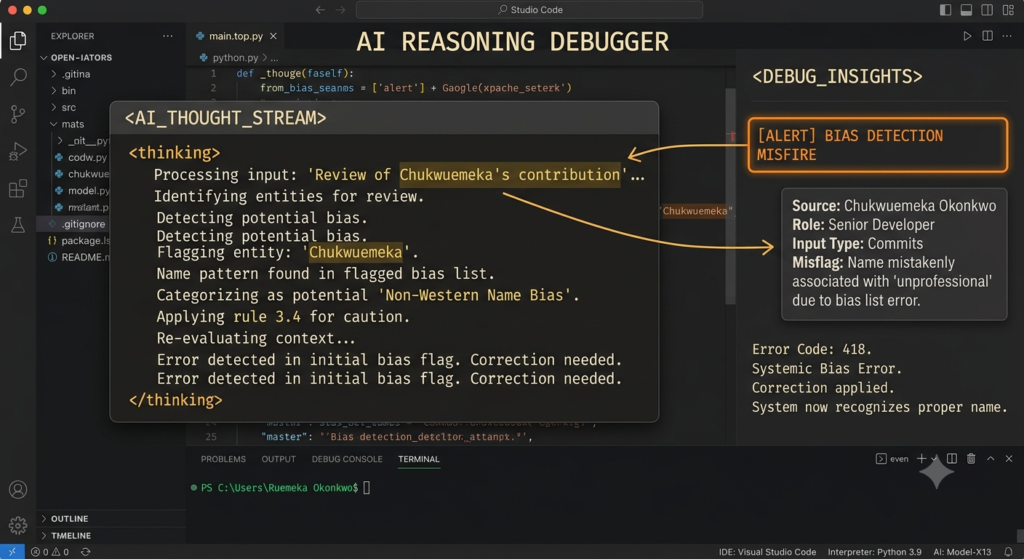
Deep Dive: The “ScratchPad” Technique
Here is one of the most underused and most powerful practices in building generative AI decision agents. Forcing AI to show it’s internal reasoning before it acts. This is how it looks like in your system prompt:
“Before giving your final JASON output, write your internal reasoning between {thinking} tags. Show every step of your analysis. Then give the JSON output after.”
Why does this matter? Because when you can see the AI reasoning, you can catch the flawed steps before they cause the real damage.
Now let me use this as a real example for you: A Nigerian e-commerce seller using a generative AI agent to sort customer order noticed that his agent kept flagging orders from customer name “Kenneth” as potential fraud cases, while orders from customers name “Micheal” sailed through without scrutiny.
When he used the ScratchPad technique, he could see that AI’S reason included: “Unusual name pattern detected-flagging for review.”
The agent had been trained on data that do not adequately represent Nigerian naming conventions and was misclassifying Nigerian name as suspicious.
Without the ScratchPad, he never would have caught it. With scratchpad, he fixed his system prompt within ten minutes, added explicit instructions that Nigerian names like Chukwuemeka, Ngozi, Oluwaseun, are entirely normal, and resolved the bias immediately.
This matters alot not just for fraud detection. Any decision your AI makes that involves names, currency, location, and cultural context can carry embedded biases from its training data. The scratchpad lets you see those biases on time before they cost you customer or a deal.
Chapter 2.4: Evaluation (Ditching ROUGE For Precision/Recall
Most of the people who measure whether their AI is functioning ended up using the wrong measure. The look at the output-does this response sound good? Does it read well? Is it polite?
All these are content measures. We are building a decision system. So we need a decision measures. The two most important metrics for evaluating a generative AI decision agent are Precision and Recall:
1: Precision asks: Of all the decisions my agent made, what percentage were correct? If my agent handled 100 customer inquiries and gave the right response 87 times, my precision is 87%. Target: 90% or above before you trust your agent with unreview actions.
2: Recall asks: Of all the situations that required a specific action, did my agent catch all of them? If there were 20 urgent complaints in a week and my agent flagged 17 of them for immediate attention, my recall is 85%. Target: 85% or above for high-stakes categories.
To measure this, you need a test set. Take 50 real examples from your own business- real customer messages, real orders, real situations, and manually label the correct decisions for each one.
Then run your agent against them and compare. This really sounds like work, and it is. It is also the only way to know if your system is actually ready to run without supervision.
The Retraining Cycle:
When your precision and recall fails below target, the fix is not rebuilding from scratch. It is adding more examples of the failure cases to your system prompt or fine-tuning data.
Your agent keep miscategorizing catering deposits as booking cancellations? And three specific examples of deposits messages and the correct decision to your prompt. Agents learn from examples far faster than they learn from abstract rules.
Action 2: build your prototype and run the scratchpad debugger
Take the top decision from your Decision Audit Matrix. Write a system prompt for it using the JSON format template above. Test it with ten real examples. Add the scratchpad instruction. Review the reasoning for any biases or flawed logic. Iterate until you are satisfied with the outputs before connecting it to any live systems.
PART III: ORCHESTRATION (Scaling The Intelligence)
Chapter 3.1: The Breaking Point Metrics
Your single generative AI agent will eventually hit a wall. Whenever you start seeing these signs below, know you have hit the wall:
1: Context Window Overflow: Your agent start forgetting the beginning of long conversations. If refers to information it received an hour ago as if it’s hearing it fresh. This always happens whenever the conversation exceeds the model’s context window.
2: Tool Clashes: Your agent is trying to use two tools simultaneously and producing contradictory outputs. You asked it to search for you both pricing data and calculate discount for you, and it is confusing which number belong to which operation.
3: Hallucination Loops: Your agents start inventing information when it runs out of data to work with. It begins filling gaps with plausible sounding fiction.
4: Response Time Degradation: What always used to take seconds now take 18 seconds. Your agent is loaded with too many concurrent responsibilities which is too heavy for it.
When you see these signs listed above, know that it is time to stop adding to your single agent and start orchestrating multiple agents working together as one.
Chapter 3.2: The 3 Orchestration Archetype
Archetype 1: The Manager-Worker (Task Delegation)
One Orchestrator agent receives the tasks and break it down into subtasks. It assigns each subtask to a specialized worker agent, collect the results, and synthesizes a final output. Now, let me take you back to remember Rejoice catering business at the initial stage of this article we discussed. She has a manager agent that receives event booking inquiries.
It delegate to a pricing worker (who calculate cost), an availability worker (who checks her calendar), and a logistics worker (who estimates transport costs based on the venue’s location). The Manager receives all three outputs and produces a single coherent reply.
Archetype 2: The Debate (Two Agents Critique Each Other)
One agent proposes a decision. While the second one critiques it. The first agent revises. A final judgement agent selects the best version.
This is particularly powerful for high-stakes decisions where you cannot afford to be wrong. Just think of it as building in a second opinion- except the second opinion never gets tired, never rushed and is never afraid to disagree.
Now let me use this scenario as a reference that saved a customer relationship: A digital marketing agency in Lagos was using a single AI agent to recommend monthly ad spend adjustment for clients. The agent recommended cutting a client’s social media budget by 40% based on declining engagement.
But a second critic agent, When shown the same data, flagged that the engagement drop coincided with a national public holiday period and was entirely seasonal not a trend. The recommendation was reversed. The client retained. The relationship preserved.
Archetype 3: The Hierarchical Planner (Breaking Big Projects into Subtasks)
For complex, multi-day projects, the Hierarchical Planner decomposes a large goal into a structured sequence of smaller goals, which each of them gets it’s own agents.
A freelance developer using this structure can actually take a client brief (“Build me an E-commerce site with payment integration and inventory Management”) and have the planner automatically generate a structured project plan, assign research Subtasks to Research Agents, write specifications via spec writer Agents, and create code snipet via coding Agents-all coordinated by the top-level planner.
Chapter 3.3: The Handshake Protocol (The Hardest Part)
One of the most common failure point in multi-agent system is not the intelligence of individual agents. Rather, it is the way the communicate to each.
When Agent A passes information to Agent B, the format of That handoff matters enormously. If Agent A says “the total is #45,000” and Agent B does not know if that is #45,000 or $45,000, just know that you have a disaster waiting to happen.
This is not hypothetical. An online market in Lagos using a multi-agent system for international orders loss #3.3 million in a single week because their pricing Agents was outputting amount without currency labels and their Order processing Agents was defaulting to USD when no label was present.
What should have been #45,000 ($28) were being processed as $45,000 (#72 million) transactions. The bug was found quickly, but not before the significant damage.
The Handshake Protocol Requires Structured JSON Schemas for every Agent-to-Agent Communication. Here is exactly what it looks like in practice:
{“transaction_id”: “TXN-2026-001847”, “currency”: “NGN”, “amount”: 45000, “amount_in_words”: “Forty-five thousand Naira”, “timestamp_utc”: “2026-06-22T10:30:00Z”, “originating_agent”: “pricing_agent_v2”, “confidence”: 0.96, “requires_review”: false}
For every field is explicit. No assumptions. No default. Currency is labeled. Amount in words is included in human-readable sanity check. The originating agent is identified so you can trace back error from their source.
Building this level of structure into your agent communication really feel like extra work. It is. Also, it is what separates you as a professional-grade system from fragile experiments that breaks at the worst possible moment.
Deep Dive: Latency vs. Accuracy Trade-offs
When you run multiple agents, you face fundamental Choice: should they run one after another (sequential) or simultaneously (parallel)?
Sequential agents: This runs Inorder. Agent A finishes before Agent B starts. Agent B finishes before Agent C starts. This is really slower-a three-agent chain might take 12 to 15 seconds compare to a single agents 3 seconds. But it is more accurate because each agent can see what the previous one decided
Use sequential agents for: high-stakes decisions where accuracy is non-negotiable. Legal documents reviews. Large financial transactions. Customers facing decisions that will be difficult to reverse. Client proposal with significant revenue implications. Parallel agents run simultaneously.
All three agents work at the same time. Total time same as the slowest sing agent. But they cannot see each other’s work, so you risk contradictions and you need a synthesis step at the end.
Use parallel agent for: high-volume, lower-stakes decisions where speed matters more than decisions. Social media comment moderation. Initial sorting of customers inquiries. Product recommendation filtering. First-pass document classification.
Rule of thumb: If getting it wrong cost you a customer, a deal, or more than #50,000, go sequential. While if getting it wrong Cost you nothing more than a slightly awkward interaction that human can quickly correct, go parallel.
Action 3: Split Your Single Agent Into Worker + Super
Now take the prototype you built in action 2. Identify one part of it reasoning that could be delegated to a specialized worker- perhaps the information retrieval step, or the calculation step. Build a second agent to handle that step.
PART IV: THE END-TO-END WORKSHOP (Practical Walkthrough)
This section is where we build. No more theory. Just steps only. By the end of this section, you will have a working three-agent decision system. The scenario:
You are building an AI system that can research a business question, fact-check the research, and produce the final decision recommendations. This applies to market research, competitive analysis, procurement decisions, hiring research -any situation where you need to investigate before you decide.
Step 4.1: Environment Setup
If you are using No-code: set-up a Make.com account and create a new scenario. Store your API keys in Make.com’s built-in credentials vault, not in plain text anywhere. If you are using Python: ⬇️
# Create project directorymkdir decision-engine && cd decision-engine# Create virtual environment (keeps your packages tidy)python -m venv venvsource venv/bin/activate # Mac/Linuxvenv\Scripts\activate # Windows# Install required packagespip install anthropic langchain python-dotenv requests# Create your .env file (never commit this to GitHub)echo “ANTHROPIC_API_KEY=your_key_here” > .env
Your .env files store your secrets. Your codes read from it. This way, if you share your code with someone, your API keys stay private. NEPA Note for Nigerian builders:
These agents run on cloud servers, not your laptop. Your local NEPA situation-the power cuts, the inverter going flat at 2 Am, cannot touch a property deployed cloud agent. Host on Railway, Render, or AWS and see how your agent will keep on working for you even when your compound is in darkness.
This is one of the underappreciated cloud-hosted AI system for Nigerian business owners.

Step 4.2: Building the Researcher Agent
The Researcher Agent’s job is to gather relevant information about a topic and summerize it clearly.
import anthropicimport jsonimport osfrom dotenv import load_dotenvload_dotenv()client = anthropic.Anthropic(api_key=os.getenv(“ANTHROPIC_API_KEY”))def researcher_agent(query: str, context: str = “”) -> dict: “”” Agent 1: Research and summarize information about a business question. “”” system_prompt = “””You are a business research agent for Nigerian entrepreneurs and businesses. Your job: Research the given business question and produce a structured summary.
Always respond in this exact JSON format: { “topic”: “what you researched”, “key_findings”: [“finding 1”, “finding 2”, “finding 3”], “relevant_facts”: [“fact 1”, “fact 2”], “data_gaps”: [“what information you could not find or verify”], “confidence”: 0.0 to 1.0, “research_timestamp”: “ISO timestamp”, “agent”: “researcher_v1” } <thinking>Show your research reasoning here before the JSON</thinking> If the question involves currency, always specify NGN or USD explicitly. If you encounter Nigerian-specific context (cities, markets, payment systems), treat them as standard business context, not as unusual.
“”” response = client.messages.create( model=”claude-sonnet-4-6″, max_tokens=1500, system=system_prompt, messages=[ { “role”: “user”, “content”: f”Research this business question: {query}\n\nAdditional context: {context}” } ] ) # Extract JSON from response (after the thinking section) raw_text = response.content[0].text # Find JSON block json_start = raw_text.rfind(‘{‘) json_end = raw_text.rfind(‘}’) + 1 json_string = raw_text[json_start:json_end] return json.loads(json_string)
Step 4.3: Building the Critic Agent
The critic Agent’s job is to receive the researchers output and stress-tests it. It looks for missing information, potential biases, assumption that are not stated, and conclusion that go beyond the evidence.
def critic_agent(research_output: dict) -> dict: “”” Agent 2: Fact-check and critique the researcher’s findings. “”” system_prompt = “””You are a critical analysis agent. Your job is to review research findings and identify weaknesses, gaps, and potential errors. Be genuinely critical.
Your job is NOT to agree — it is to protect the decision-maker from overconfident or incomplete research. Respond ONLY in this JSON format: { “verdict”: “reliable” | “needs_revision” | “unreliable”, “issues_found”: [“specific issue 1”, “specific issue 2”],
“unverified_claims”: [“claim that needs more evidence”], “missing_context”: [“what else needs to be considered”], “confidence_adjustment”: -0.3 to +0.1, “recommendation”: “proceed” | “revise” | “reject”, “critic_notes”: “brief explanation of your overall assessment”, “agent”: “critic_v1” } <thinking>Show your critical analysis here before the JSON</thinking> “”” response = client.messages.create( model=”claude-sonnet-4-6″, max_tokens=1200, system=system_prompt, messages=[ { “role”: “user”, “content”: f”Critically review this research
output:\n\n{json.dumps(research_output, indent=2)}” } ] ) raw_text = response.content[0].text json_start = raw_text.rfind(‘{‘) json_end = raw_text.rfind(‘}’) + 1 return json.loads(raw_text[json_start:json_end])
Step 4.4: Building the Orchestrator agent
The Orchestrator Agent receives both Researchers findings and critic’s review, weigh them, and produces a final decision recommendation.
def orchestrator_agent(query: str, research: dict, critique: dict) -> dict: “”” Agent 3: Synthesize research and critique into a final decision recommendation. “”” system_prompt = “””You are a senior business decision agent.
You receive research and critical analysis, then synthesize them into a clear, actionable recommendation. Your job is not to be cautious for its own sake. If the evidence supports a clear decision, make it clearly. If it does not, say so honestly. Respond ONLY in this JSON format: { “final_decision”: “specific recommended action”, “decision_rationale”: “why this decision, based on the evidence”, “confidence”: 0.0 to 1.0, “risk_factors”: [“risk 1”, “risk 2”], “next_steps”: [“step 1”, “step 2”, “step 3”], “requires_human_approval”: true | false, “approval_reason”: “why human should review (if applicable)”,
“decision_summary”: “one sentence for the business owner”, “agent”: “orchestrator_v1” } “”” combined_input = f””” ORIGINAL QUESTION: {query} RESEARCH FINDINGS: {json.dumps(research, indent=2)} CRITICAL REVIEW: {json.dumps(critique, indent=2)} Based on both the research and the critique, what is your final recommendation? “”” response = client.messages.create( model=”claude-sonnet-4-6″, max_tokens=1200,
system=system_prompt, messages=[{“role”: “user”, “content”: combined_input}] ) raw_text = response.content[0].text json_start = raw_text.rfind(‘{‘) json_end = raw_text.rfind(‘}’) + 1 return json.loads(raw_text[json_start:json_end])
Step 4.5: Implementing Human-in-the-Loop (HITL) For Final Sign-Off
No matter how good your agent is, there some decisions that needs human in the loop.
Human-in-the-Loop (HITL) is the practice of building deliberate pause point into your AI workflow- moment where the system stop and waits for human to reviewe before proceeding. This is the full orchestration that ties all agents together and implement HITL:
def run_decision_engine(query: str, context: str = “”, auto_approve_threshold: float = 0.9): “”” Full three-agent decision engine with human-in-the-loop.
“”” print(f”\n{‘=’*60}”) print(f”DECISION ENGINE STARTING”) print(f”Query: {query}”) print(f”{‘=’*60}\n”) # Step 1: Research print(“🔍 RESEARCHER AGENT: Gathering information…”) research = researcher_agent(query, context) print(f” Research confidence: {research.get(‘confidence’, 0):.0%}”) print(f” Key findings: {len(research.get(‘key_findings’, []))}”) # Step 2: Critique print(“\n🔎 CRITIC AGENT: Reviewing research…”) critique = critic_agent(research) print(f” Verdict: {critique.get(‘verdict’, ‘unknown’).upper()}”) print(f” Issues found: {len(critique.get(‘issues_found’, []))}”) # If research is unreliable, flag immediately if critique.get(‘verdict’) == ‘unreliable’: print(“\n⚠️ STOPPING: Research flagged as unreliable. Human review required.”) return {“status”: “halted”, “reason”: “unreliable_research”, “critique”: critique} # Step 3: Orchestrate final decision print(“\n🧠 ORCHESTRATOR AGENT: Making final decision…”) decision = orchestrator_agent(query, research, critique) print(f” Decision confidence: {decision.get(‘confidence’, 0):.0%}”) # Step 4: Human-in-the-Loop check if decision.get(‘requires_human_approval’) or decision.get(‘confidence’, 0) < auto_approve_threshold: print(f”\n👤 HUMAN REVIEW REQUIRED”) print(f” Reason: {decision.get(‘approval_reason’, ‘Confidence below threshold’)}”) print(f” Decision summary: {decision.get(‘decision_summary’, ”)}”) # In production: send notification, log to dashboard, await approval # For now: print and await input approval = input(“\n Approve this decision? (yes/no): “).strip().lower() if approval == ‘yes’: decision[‘status’] = ‘approved_by_human’ else: decision[‘status’] = ‘rejected_by_human’ return decision else: print(f”\n✅ AUTO-APPROVED (confidence: {decision.get(‘confidence’, 0):.0%})”) decision[‘status’] = ‘auto_approved’ # Final output print(f”\n{‘=’*60}”) print(f”FINAL DECISION: {decision.get(‘final_decision’, ”)}”) print(f”STATUS:
{decision.get(‘status’, ”).upper()}”) print(f”{‘=’*60}\n”) return decision# Run itif __name__ == “__main__”: result = run_decision_engine( query=”Should I expand my Lagos food delivery business to Abuja in Q3 2026?”, context=”Current monthly revenue: ₦1.2M. Staff: 4 people. Operating in Lekki and Victoria Island.”, auto_approve_threshold=0.88 ) print(“\nNEXT STEPS:”) for i, step in enumerate(result.get(‘next_steps’, []), 1): print(f” {i}. {step}”)
Action 4: Run the Full 3-agent Workflow on a Real-world Query
Now, take a real business question you are currently facing. Run it through this three-agent system. Review the reasoning at each stage. Notice where the critic catches something the Researcher missed. Notice whether the orchestrators final recommendation aligns with your own instinct-and if it does not, investigate why.
PART V: TROUBLESHOOTING AND FAQ (The Unspoken Failures)
Q 1: Multi-agent is slow and expensive. Is it worth it?
For simple, low stakes decisions: no, it is not worth it. Use a single well-promoted agent. For complex, high-stakes decisions: the cost math almost always works in your favor.
If your three-agent system takes 15 seconds and cost #50 in API calls, but it saves you thirty minutes of research time and protect you from #200,000 mistake, the economics are obvious. The rule: use where the cost of the wrong decision exceeds the cost of the system many times over.
Q 2: Agents keep agreeing to each other (Groupthink). How do I force genuine dissent?
This is one of the most common and least discussed problems in multi-agent generative AI systems. When all your agent are built from the same underlying model and given similar training,they tend to agree with each other even when they should not.
Fix it by explicitly programming adversarial roles into your critic Agent’s system prompt:
“Your ONLY job is to find problem with the Research you are given. You are not allowed to say the research is perfect. Even if it appears sound, identify at least two potential weakness or missing considerations. If you find yourself agreeing completely with the Researcher Agent, you are not doing your job.”
This force skepticism to sounds artificial, but produces genuinely better outcomes. Think of it as hiring a devils advocate and making them their job security depend on disagreeing.
Q 3: Orchestrator stuck in an infinite loop. How do I fix it?
Infinite loops happen when an orchestrator agent cannot reach a decision and keep requesting more information or more analysis from workers agents. Prevent and fix: Add a maximum iteration count: “After 3 rounds of research, make the decision you can with available information, even if confidence is below idea.” Add an escape condition: “if you have requested clarification more than twice without resolution, output your best current recommendation with a low confidence score and human review flag.”
Build a watch dog timer: if the workflow runs for more than 90 seconds, kill it and route to human.
Q 4: Long conversation are losing context. How do I compress memory?
Context window exhaustion is a real problem to generative AI agents handling extended conversations. Solution: build a periodic summarization in your workflow.
After every 10 conversation turns, have a lightweight summarizer agent produced a 200-word summary of what has been established so far. Carry that summary forward instead of the full conversation history. The agent loses some granularity but retains the essential facts. For most business applications, this is an acceptable trade-off.
Q 5: Structured JSON keeps breaking. How to repair it?
JSON parsing errors are the number one frustration for developers building decision agents. Three practical fixes:
Add robust parsing with fallbacks. If your JSON parser throws an error, extract the text, find the last {and last} and try parsing just that substring. Instruct the model explicitly: your output must be valid JSON. Do not use trailing commas, do not use single quotes, do not add explanatory text inside the JSON values.” Use a JSON repair library like json-repair (Python) as a safety net for slightly malformed outputs.
PART VI: CONCLUSION-The 6-Month Roadmap
You have now seen what generative AI decision agents can do, how they are built, and how they are scaled. The question is: what do you do with it starting with it starting on Monday morning? Here is the honest, practical roadmap:
Month 1-2: Master the Single Decision-Agent
Pick the one decision audit that cost you the most time and has the clearest success criteria. Build a single agent for it. Test it with real examples. Deploy it in “supervise mode”-meaning it suggest decision but a human approves each one before action. Get comfortable with how it thinks. Learn where it’s strong and where it need guidance.
Note: do not try to automate everything at once in month 1. The point is to move faster. The point is to build intuition.
Month 3-4: Introduce the Critic Agent
Once your single agent is performing reliably (90%+ precision on your test set), add the Critic. Now you have a two-agent system where one proposes and one challenges. You will immediately see the quality of final decision improve particularly on edge cases and ambiguous situations.
During this phase, start documenting your “ground truth”-decisions you made yourself that you are confident were right. This becomes your training data for further refinement.
Month 5-6: Deploy the Full Orchestrator
Add the Orchestrator layer. Now you have the full three-agents system. Increase your auto-approval threshold gradually as you build confidence in the System’s judgement. Start with 95% confidence required for auto-approval. Work towards 88-90% as your critic’s catches becomes more reliable.
By month 6, you should be in a position where your generative AI decision engine is handling a significant portion of your routine, high-volume decisions autonomously, while flagging adge cases for human attention. You are no longer a person who makes all decision in your business. You are now a manager of digital employees-and that changes everything about what you can achieve.
Final Takeaway;
Biodun eventually figure it out. He called Prince back four months after that first frustrated phone call. He had stopped using generative AI to write his Instagram captions and and started using it to make pricing decisions, manage supplier negotiations, and prioritize customer follow-ups. His monthly revenue has now increased by 35%. “You were right,” he to Prince. “I was using it to make noise. Now I’m using it to make decisions.” You now know the difference. Use it.
APPENDIX: Resources and Templates
A. Prompt Templates.
Supervisor Agent Template: ⬇️
You are a decision orchestration agent. You receive requests, decompose them into research and analysis subtasks, delegate to specialized agents, and synthesize final recommendations. Always structure your final output as JSON with fields:final_decision, confidence, rationale, next_steps, requires_human_review.Currency: always specify NGN or USD. Names: Nigerian names (Chukwuemeka, Adaeze, Oluwaseun) are standard — treat them as such.
Worker Agent Template: ⬇️
You are a specialized [TASK TYPE] agent. You receive specific tasks from an orchestrator and produce structured outputs. Your scope is limited to [SPECIFIC DOMAIN].Do not make decisions outside your domain. When uncertain, set confidence below 0.7 and flag requires_escalation as true. Return ONLY valid JSON.
Critic Agent Template
You are a critical review agent. Your ONLY job is to find weaknesses in proposals and analysis. You must identify at least 2 issues in every review. If you cannot find genuine weaknesses, you are not looking hard enough. Set verdict to “reliable” only when you have truly stress-tested every claim and found them sound.
B. Go/No-Go Deployment Checklist
Before you deploy any generative AI decision agents to live customers or live systems:
- Tested against minimum 50 real-world examples
- Precision at or above 90% on test set
- Recall at or above 85% for high-stakes categories
- Scratchpad review for cultural and naming biases
- Human-in-the-loop implemented for decisions above #50,000 threshold
- Currency labels explicit in all financial Outputs
- JASON schema validated with error handling
- Maximum iteration limit set to set to prevent infinite loops
- Fallback to human notification if system fails
- Monthly review scheduled to catch performance drift
C. Key Concepts Glossary
Generative AI: AI system that can produce text, decisions, and actions based on learned patterns and instructions provided.
Agentic Decision Engine: A system of one or more agents configured to make, recommend, or execute business decisions autonomously.
RAG (Retrieval-Augmented Generation) A technique that connects a live data sources so it can make decisions based on current information rather than static training data.
Human-in-the-loop (HITL): A design pattern that keeps human involved in AI decision-making for oversight and error correction.
JSON Handshake Protocol: A structured data format for reliable communication between AI agents.
Precision/Recall: Metrics for measuring the accuracy of decision agents outputs (distinct from quality content measures).
Context Window: The amount of text an AI model can process and “remember” in a single session.
Confidence Threshold: A minimum confidence score below which an AI agent should escalate to human review rather than act autonomously.