
I still remember the first time a chatbot completely missed the point of what I was asking.
It was 2021, I was trying to reschedule a flight, and the bot kept looping me back to the same three canned answers no matter how I phrased the question. I eventually gave up and called the airline. That memory is exactly why the shift toward Agentic AI feels so different to me now-and probably to you too, if you have spent any time lately watching an AI tool actually finish a task instead of answering a question.
This guide breaks down the five proven differences between Agentic AI and Traditional AI, plain-language examples, real numbers and a few stories from people actually building with these tools in 2026. By them, you will know exactly which one fits your business, your project, or your next weekend aside hustle-and you will understand why so many teams are quietly replacing rule-based not with autonomous agents this year.
If you are ready to stop just dreaming and start banking, dive into my 7 Proven Ways to Make Money in Nigeria these are the exact methods winning in 2026.
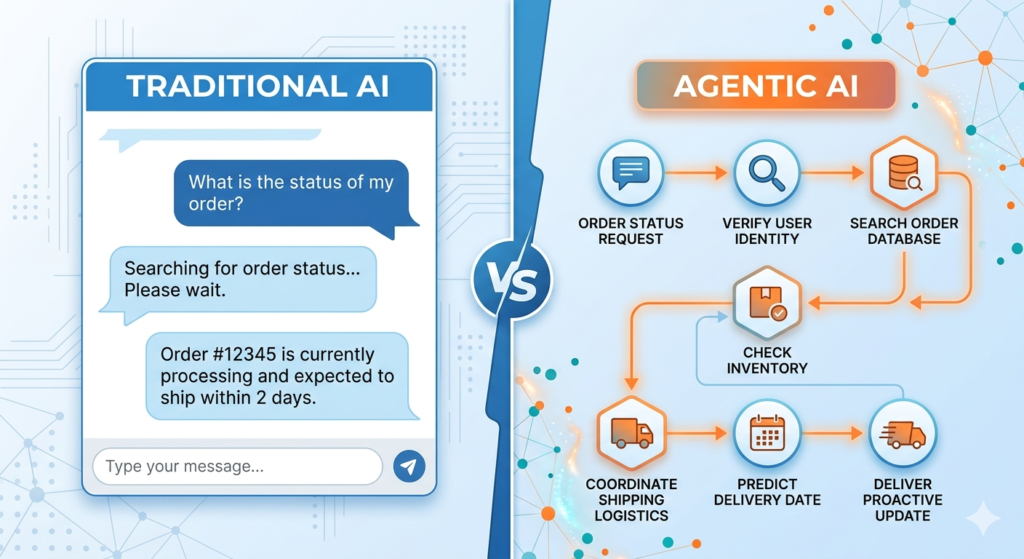
Table of Contents
Why So Many People Are Confused About Agentic AI And Traditional AI Right Now
Here is the honest truth: Most confusion isn’t your fault. Marketing team have slapped the word “AI” on everything from a spam filter built in 2015 to a fully autonomous research agent built last month. They are not the same thing. But they get lumped together in headings consistency.
The confusion often stems from not understanding the core differences between Agentic AI and Traditional AI in a business setting.
I talked to a small business owner in Austin last year-she runs a boutique skincare shop-who told me she’d already been using “AI” for two years through her email platform’s subject-line suggestions. When her nephew mentioned he’d set up an agent that handle entire Instagram DM funnel overnight, she assumed it was the same kind tool, just a newer version. It wasn’t. One was traditional AI giving suggestions. The other was Agentic AI running an entire workflow without her watching it.
The gap-between AI that suggests and AI that does-is what this whole guide is about.
What This Guide Will Clear Up for you
By the end of this article, you will discover:
- What traditional actually is (and where it still make sense to use)
- What Agentic AI is and how it operate without constant supervision.
- The five core differences between the two, with real-world, relatable examples.
- Where each one fits in an actual business-not just a hypothetical one
- How people are starting to earn income by building Agentic AI systems for local businesses.
Quick Summary: The 30-Second Summary
If you only have a minute, here’s the gist. Traditional AI is reactive-it does one thing When you ask it to, like sorting emails or recognizing a face in a photo.
Agentic AI is proactive-you give it a goal, it plans, execute multiple steps, check it’s own work, and adjusts along the way, often without you touching it to you again. The five difference that matter most is autonomy, decision-making, memory, tool integration, and adaptability. We are going to walk through every one of them with examples you will actually recognized with your own life or business.
Section 1: Understanding the Basics
1:1 What is Traditional AI? ( The tech You Already Know)
Traditional AI is the AI most of us grew up with without even realizing it. It’s the spam filter that’s been quietly protecting your inbox since 2010. It is the recommendation engine on a streaming app that says “because you watch this, you might like That.” It’s a model trained on a fixed data set to do one job, and one job only, really well.
To really grasp and understand the shift in technology, we must look at the specific capabilities of Agentic AI and Traditional AI.
The core Idea behind traditional AI is pattern recognition within a defined boundary. You feed it labeled data, it learns the pattern, and then it applies that pattern to new inputs. It doesn’t wonder what to do next. It doesn’t remember your last conversation. It only does the tasks in front of it and stops.
How it works, Step-by-Step:
1. A dataset is collected and labeled(Think: thousands of emails marked “spam” or not spam”)
2. A model is trained on that dataset until it recognizes the pattern reliably.
3. The model is deployed to make predictions on new, unseen data
4. If the pattern changes in the real world, the model needs to be retrained- it won’t catch the shift on its own.
knowing the limit of the traditional system is the first step when comparing traditional AI and agentic AI.
Real examples you have used today, probably without thinking about it:
- Spam filters in Gmail or Outlook
- Image classifiers that tag your photos by what is in them
- Recommendation engines on Amazon, Netflix, Spotify
- Basic chatbot that answer FAQs from a fixed script
Traditional AI is still the right tools for a huge number of jobs. If you need a fast, predictable, narrow tasks done-classify this, sort that, flag this-traditional AI is often cheaper, faster and more reliable than anything Agentic. Don’t let anyone tell you it’s obsolete. It’s just not built for open-ended work.
1.2 What is Agentic AI ? ( The Shift Everyone’s Talking About)
When analyzing the rapid evolution of digital tools, the debate regarding traditional AI vs agentic AI becomes central to productivity.
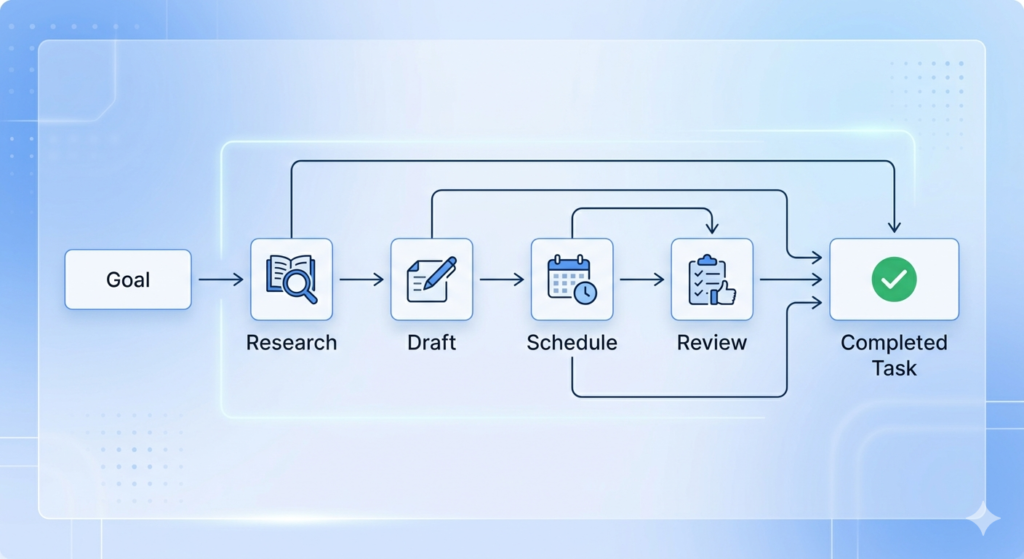
Agentic AI flips the model. Instead of asking “what’s the answer to this one question,” you’re asking”go achieve this goal, and figure out the steps by yourself.” That’s the heart of it. You give Agentic AI system a destination, not a set of turn-by-turn directions, and it plans the route, drives there, and tells you when it’s done-or ask for help if it hits a wall it can’t solve alone.
I think of it like the difference between a vending machine and a personal assistant. A vending machine (Traditional AI) gives you exactly what you press button for-nothing more, nothing less. A personal assistant (Agentic AI) hears “we need to fix our event button” and it goes off to compare vendor quotes, draft an email, check your calendar for a meeting slot, and come back with a recommendation.
Why burning yourself out doing manual tasks when you could let the technology handle the heavy lifting for you? This guide ➡️ AI Automation for Small Business Owners: How to Automate Your Entire Customer Journey will help you learn how to automate your entire customer journey and finally reclaim your precious time.
How Agentic AI Actually Works Step-by-Step:
1.You give it a goal not a single instruction (“grow our newsletter list” instead of “write one email”)
2. It breaks that goal down into sequence of sub-tasks
3. It select which tools or system needs(a CRM, an email platform, a Database) to complete each sub-task
4. It execute the plan, checking the results as it goes.
5. If something doesn’t work, it adjust the plan instead of just failing
6. It reports back, often with a summary of what it did and why
Real examples that are already running right now, in 2026:
- AI assistants that manage the entire inbox triage, not just flag spam
- Autonomous developer agent that can read a big report, locate the file, write a fix, and open a pull request
- Multi-agent orchestrations where one agent researches another drafts, and a third reviews-all without a human in the loop until the final check
This is why Agentic AI is fundamentally different from chatbot. A chatbot answers what you type. An agent pursues what you wanted, even across multiple steps you can never explicitly ask for.
1.3 The Key Difference : Autonomy (And Why It Matters More Than You Think)
If you remember only one thing from this entire guy, please make it this: Traditional AI requires human input at every step, Agentic AI operates independently toward a goal.
That single distinction is the roof of every other difference we are about to cover. Once a system act without waiting for your next click-everything changes-how much oversight it needs, how much it can scale, and honestly, how much trust you have to be willing to extend it to.
A friend of mine who runs small accounting from ohi out it well: “I don’t need an AI to tell me what’s in a spreadsheet. I need one that notices something’s wrong in the spreadsheet, flags the client, and draft the follow-up emails before I have before I have even opened my laptop.” That’s Autonomy. That is Agentic AI difference in one sentence.
This level of autonomy is exactly where the gap between traditional AI and agentic AI widens significantly.
Section 2: The Proven 5 Differences Between Agentic AI and Traditional AI
This is the core of the guide. Each difference include a side by side comparison, two grounded real examples, and honestly “why this matters” takeaway-not hype, just what it actually changes for you.
Difference 1: Autonomy Level
Traditional AI waits for Command,
Agentic AI Takes Initiative.
| Aspect | Traditional AI | Agentic AI |
|---|---|---|
| Input Required | Explicit human instruments | Minimal human direction |
| Take Ownership | Gives out put when prompted | Breaks down tasks, complete goals |
| Planning | No planning ability | Plans before acting |
| Initiative | Reactive only | Proactive, anticipates next steps |
| Autonomy score | Low | High |
Real-world Examples-Email Marketing:
A traditional AI tool draft an email or suggests three subject-line when you ask. That is it. An agentic AI systems, told to “improve our email compaign performance,” will go analyze past compaign data, identify what actually droves opens and clicks, segment your audience by behavior, draft personalized version for each segment, schedule them at the times your data shows people actually open email, and then come back a week later with a refinement base on the results. You said one sentence. It ran an entire cycle.
Real-world Examples-Customer Support:
Picture a furniture company in Portland shipping a coaches that get delayed by a snowstorm. A traditional AI Chatbot will only reply if the customer happens to message in and ask “where is my order.”
An agentic AI system monitors the shipping carrier’s API directly, detect the delay before the customer even notices, automatically email them with apology and a revised delivery window, and logs the incident for the support team-all without anyone refreshing the tracking page.
Why This Changes Everything:
- Reduces the need for constant human oversight by a wide margin
- Makes real 24/7 business operations possible-not just availability
- Frees up the kind of mental bandwidth that used to go toward “did anyone check on this” anxiety
This is the reason why when managers assess traditional AI vs agentic AI, they almost always choose agents for complex workflow.
Difference 2: Decision-making capability
Traditional AI follows rules. Agentic AI makes real, contextual decisions
| Aspect | Traditional AI | Agentic AI |
|---|---|---|
| Decision Type | Limited, rule-based | Context-aware decision |
| Variables Considered | Single factor at a time | Multiple variables simultaneously |
| Error Handling | Fails or throws an error | Self-corrects or re-routes |
| Reasoning | Pattern matching only | Contextual, goal-based dynamic |
| Judgement | None | Real judgement within context |
Real-world Example-Marketing Automation:
A rule-based traditional AI tool send the exact same promotional email to your entire list, Everytime, regardless of who they are. Agentic AI looks at individual customer behavior-when they typically open email, what kind of subject lines they have engaged with before-and choose different timing and content for different people, then adjust the next send if a particular group didn’t respond.
Real-world Examples-Sales Pipline:
A traditional system might take a lead as “hot” simply because they click a pricing page once. That’s single metric, and it’s often wrong. An Agentic AI systems weighs Engagement history, state budget, timeline urgency, and how the lead responded to past interactions, then recommend the actual best next move for that specific person-maybe a phone call instead of another email, or a case Study instead of a discount code.
Why This Changes Everything:
- It handles the kind of messy, multiple variable situation that used to require a human’s guy instinct
- It adapts to shifting market conditions without someone manually rewriting the rules
- It tends to create a noticeably better customer experience, because people can feel when something is actually tailored to them
Difference 3; Memory and Learning
Traditional AI has no memory. Agentic AI learns from every interaction.
| Aspect | Traditional AI | Agentic AI |
|---|---|---|
| State | Stateless or snapshot-based | High context awareness |
| Memory Type | None-loses context between prompts | Persistent short-term and long-term memory |
| Improvement | Needs retraining on new labeled data | Learn from experience, adapts in real time |
| Context Use | Low | Use memory plus situational context |
| Learning Method | Centralized model training | Embedded memory and self-correction |
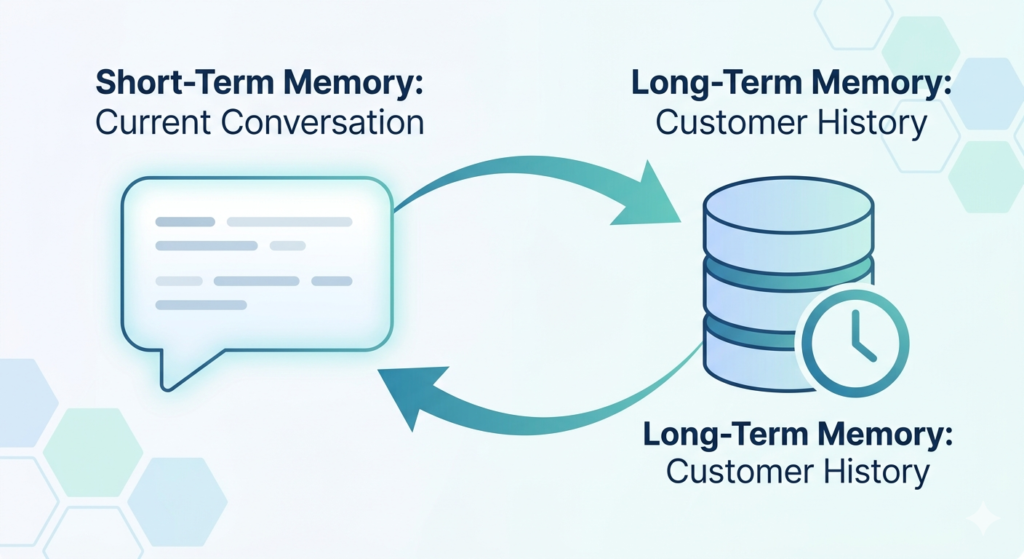
A quick technical note here: a lot of Agentic AI memory is powered by vector databases, which store information as mathematical representation of meaning rather than rigid rows in a Short-term memory tends to cover current conversation or task. Long term memory holds onto memory over time-a customer’s preferences, past complaints, or buying habits-and pulls that content back in when it’s relevant later.
Real-world Examples-Customer Support
Traditional AI treats every customer querry like it’s the very first time anyone has ever talked to that person. No memory, no history, just the words in front of it right now. Agentic AI remember that this particular customer had a billing issue three months ago, prefers email over chat and tends to get frustrated by long hold times-so it adjusts it tone and approach accordingly, the same way a good employee who’s worked the same desk for years would.
Real-world Example Personal Shopping
A traditional recommendation engine suggests product based on what you searched five minutes ago. An Agentic AI shopping assistant remembers that you bought a winter coat last November, tend to shop sales in your favorite brand, and have a budget ceiling you rarely cross-so the recommendations it makes a year later are actually grounded in who you are, not just what you clicked once.
The ability to remember context is a major advantage when evaluating agentic
Why this Changes Everything:
- Personalization becomes possible at a scale no human team could manually replicate
- The system genuinely improves on over time, which compounds into better return on investment the longer it runs
- It builds the kind of relationship-feeling loyalty that used to require a small, dedicated human team
Difference 4: Tool Integration
Traditional AI lives inside itself.
Agentic AI connects to everything.
| Aspect | Traditional AI | Agentic AI |
|---|---|---|
| Scope | Internal algorithms only | External tool and environment interaction |
| Communication | Minimal, standalone or API-bound | Rich multi-agent and human interaction |
| Tool Access | Fixed scripts | APIs, databases, web tools, software |
| Exercution | model inference only | Multi-step actions and workflows |
| Agency | None-tools built for humans to operate | Explicit goals, self-direc |
Tools Agentic AI regularly connect to in 2026:
- CRM platforms like Salesforce and HubSpot
- Email platforms like Gmail and Outlook
- Payment processors like stripe and PayPal
- Social platforms including Instagram, X, and LinkedIn
- Database systems such as SQL or MongoDB
- Web scraping and research tools
- Calendar and scheduling apps
Real-world Example – Content Creation:
Traditional AI writes you a blog post, you now start your own work by: copying it, formatting, and you log into your WordPress, publish it, distribute it to your social media platforms, and later you come back to see how engageful they are. Agentic AI writes the post, you publish it to your website directly, and distribute it to social channels, track the engagement automatically, it is now the results of the engagement will determine how your next post will be.
Real-world Example – Business Operations:
A small distribution company in Chicago used to have someone pull sales numbers from a database every Monday, build report by hand, and email it to the team.
An agentic AI system now pulls the same data, Analyzes the week trends, generate the report, drops it directly into the team’s slack channel, and schedules a follow up meeting automatically if the numbers show something that actually needs discussion-and it automatically updates the CRM with the relevant notes while it’s at it.
Why this Changes Everything:
- One agent can effectively run a workflow that used to require coordinating several different tools manually.
- It eliminate the tedious, repetitive cross-platform busywork that used to eat up so much of a work day
- It genuinely creates “set it up once, let it run” systems-not a perfect hands-off fantasy, but a real reduction in manual touchpoints
Ready to transform from an AI observer into an AI powered-user? Click on this guide on ➡️ How to Use AI Agent Daily: The Ultimate 2026 Guide to Ending Digital Overwhelmed to discover exactly how to use AI agent daily to turn your workflow into high-octane machine.
Difference 5: Adaptability
Adaptability is perhaps the most critical factor when considering agentic AI and Traditional AI for your own operations
Traditional AI breaks when things change.
Agentic AI adapt automatically.
| Aspect | Traditional AI | Agentic AI |
|---|---|---|
| Environment Handling | Struggles with changing conditions | Continuously adapts to new information |
| Flexibility | Needs manual oversight as system grow | Coordinates whole system on its own |
| Protocol | Follows strict,flexed rules | Adjusts actions based on Live feedback |
| Focus | Task-specific narrow | Goal-oriented broader objective |
| Adaptability Score | Low-needs retraining | High – learns in real time |
Real-world Example – Marketing Compaign
A traditional AI tool will keep running the exact ad compaign even after a competitor drops their prices and the market shifts under your feet. Agentic AI monitors competitor pricing in something close to real time, adjusts your compaign strategy, test new messaging angles, and optimizes toward conversations as conditions change-not once a quarter when someone remembers to check, but continuously.
Real-world Example – Supply Chain:
A logistics traditional AI system follows the route it was given, full stop, even if a storm shut down the highway way it’s relying on. Agentic AI detect the weather delay, re-routes the shipment automatically, notifies the customer proactively, and updates the inventory system so nobody downstream gets caught off guard by a delivery that quietly never showed up.
Why This Changes Everything:
- It helps business survive real market volatility without someone manually intervening every single time
- It keeps a company competitive almost automatically, because the system is always reading the current conditions
- It meaningfully lowers the operational risk of small business getting blindsided by something it didn’t see coming
Section 3: Comparison Summary-Agentic AI vs. Traditional AI at a Glance
The final break down of agentic AI and traditional AI clearly shows
3.1 The Complete Comparison Table
| Feature | Traditional AI | Agentic AI |
|---|---|---|
| Autonomy | Requires human input | Operate independently |
| Decision-Making | Ruled-based | Context-aware |
| Memory | Stateless, no retion | Persistent memory |
| Free Integration | internal only | External APIs tools |
| Adaptability | Fragile, static | Dynamic-self correcting |
| Execution Model | Batch or synchronous | Asynchronous, event-driven |
| Proactivity | Rare | Core attribute |
| Learning | Needs retraining | Learns in real time |
| Scalability | Manual oversight n | Coordinate whole systems |
| Beat Fit | Simple, repeatable jobs | Complex, multiple-step operations |
3.2 Typical Use Cases, Side by Side
| Traditional AI Is Great For | Agentic AI Is Great For |
|---|---|
| Data sorting and tagging | End-to-end workflow automation |
| Image recognition | Dynamic multi-step planning |
| Basic diagnostics | Virtual assistant tasks |
| Spam filtering | Open-ended problem solving |
| Recommendation engines | Multi-agent orchestration |
| Simple classification tasks | Autonomous developer agent |
3.3 The Business Value, Honestly Frame
These numbers values a lot by industry and implementation quality, so treat them as general direction rather than guarantees:
| Metric | Traditional AI | Agentic AI |
|---|---|---|
| Typical Productivity Lift | 10-20% | 30-50% |
| Typical Cost Production | 20-30% | 40-60% |
| Innovation Speed | Baseline | Often 2-3x faster |
| Human Oversight Needed | High | Lower but,never zero |
| Scalability | Limited | Built for growth |
A word of caution that I think gets glossed over alot in guides like this: “lower human oversight needed” doesn’t mean “no human oversight needed.”
Every Agentic AI system I have personally seen work well in the real-world still has a person checking in, reviewing output periodically, and stepping in when something looks off. The goal isn’t a robot running unsupervised forever-it is a robot that doesn’t need you standing over it’s shoulder for every single click.
Section 4: Why This Matters in 2026
4.1: The 2026 Reality
The talent gap around AI implementation is real, it’s the part of the main reason why Agentic AI accelerated so fast this year. Majority of companies want to now move to autonomous systems but lack in-house people who knows how to set them up properly, which has now a real lane for Freelancers, consultants, and small agencies who knows how to do it properly.
4.2: Five Industries Where Agentic AI Is Already Pulling Ahead
1. Customer service: Moving from “chatbot answers a question” to a full workflow automation
2. Marketing: Moving from one-size-fit-all email blasts to personalized campaigns that adjusts themselves
3. Sales: Moving from single-metric lead scoring to multi-factor decision-making with strategy that shift base based on response
4. Content Creation: Moving from “writes the words” to a full pipeline, publish to analyze to refine
5. Operations: Moving from static report to end-to-end coordination across an entire workflow
Section 5: How People Are Actually Earning Income With This Right Now
This part is where you see the most trending questions by people, so let’s be honest, careful and straight forward about it.
People are steadily monetizing each of these five differences in a pretty distinct ways:
- Autonomy ➡️ Building autonomous business systems for clients, often priced per project rather than hourly
- Decision-making ➡️ Consulting on complex workflow design for businesses that need more than a basic chatbot
- Memory ➡️ Building personalized customer experience tools, particularly for service based businesses
- Tool Integration ➡️ This involves setting up multi-platform automation, connecting a client CRM, email, and social tools into one coordinated system
- Adaptability ➡️ Designing market-responsive strategies especially on e-commerce brand competing on price and timing
Some real, grounded income ranges people are actually reporting:
- A basic AI Chatbot set up for a local business: a few hundred to around a thousand dollars per setup
- Hourly AI automation consulting: roughly $100-$300 an hour depending on complexity and region
- A small, focus “Micro Saas” built around an agentic AI workflow: a meaningful monthly recurring revenue stream once it has a steady users
- Full-time roles focus on multi-agent orchestration: salaried positions that have become genuinely common at mid-size and larger companies
None of these is a guarantee, and likely any skill-based work, the income fully depend on how good you actually get at building reliable systems-not just how trendy the term “Agentic AI ” sounds on a resume.
Section 6: Frequently Asked Questions
Q1: Is agentic AI better than traditional AI for my business?
It depends entirely on the task. For complex, multi-step workflows, agentic AI win. For simple repetitive tasks where you want fast and predictable results, traditional AI is often the best, and cheaper choice to go with.
Q2: Can I use both traditional AI and agentic AI together?
Yes. This is what most well-run systems does. Traditional AI handles fast classification (is this email spam, is this image a cat) while agentic AI handles the broader workflow built around that classification.
Q3: What skills do I need to start building agentic AI systems?
A solid grounding in prompt engineering, some familiarity with multi-agent orchestration frameworks like LangGraph, AutoGen, or CrewAI, a working understanding of vector databases for memory and comfort connecting tools through APIs.
Q4: How much does it cost to implement Agentic AI?
A DIY set up using free or low-cost tools can run close to nothing pet month. Hiring a consultant for one-time setup cost range is between few hundred and several thousand of dollars although it depends on the complexity. A full enterprise-grade solution can run into the tends of thousands.
Q5: Is agentic AI only for technical people?
No. No-Code and low-code platforms have made a real dent here-tools that let non-programmers build working agents through visual interfaces rather than raw code.
Q6: When should I choose traditional AI over agentic AI?
When the task is simple and repetitive, when you want fast and fully deterministic results, when your budget is tight or when a reasonable amount of human oversight is perfectly acceptable for what you’re doing.
Section 7: Your Next Steps-A 30-Day Plan to Actually Learn This
Week 1: Foundations
Spend your first few days to understand fully what agentic AI is and isn’t, then you go back to the five differences I have already taught in this guide until they feel intuitive rather than memorized.
Week 2: Tools
Try out a framework like LangGraph, AutoGen, or CrewAI. Build the simplest possible agent-even something as basic as an agent that checks a webpage and emails you if something changes is a real, working start.
Week 3: Going Further
Add vector database so your agent can actually remember things across sessions. Now connect it to one real external APIs so it’s doing something in the world, not just inside a sandbox.
Week 4: Putting It to Use
Build a small portfolio project you can actually show someone. Reach out to one local business that might genuinely benefit from it. See where that conversation goes.
The Bottom Line ( Conclusion)
Traditional AI is reactive, rule-based, has no memory, work with limited tools, and tends to be fragile when conditions change. Agentic AI is proactive, make real contextual decisions, remembers what happened before, connect across nearly everything, and adapts automatically as the situation shifts.
Neither one is universal “better.” A spam filter doesn’t need to plan a multi-step campaign, an autonomous agent is overkill for sorting a folder photos. The skill worth building in 2026 isn’t picking Side at all-rather, it’s about knowing the right tool that actually fits the problem in front of you, the same thing applicable to a good carpenter that knows when to reach for a hand tool instead of a power tool.
If there’s one thing that worth taking away among all the five differences we have treated in guide, it’s this: the gap between traditional AI and Agentic AI isn’t really about how “smart” the system is. It’s about how much of the thinking through what to do next you are willing to hand off-and how much that frees you up to fully focus on the real part of the work that actually need a human.
Choosing between agentic AI and traditional AI depends entirely on whether your business needs a simple task-doer or an autonomous partner.