
Table of Contents
Tracking brand visibility in AI search is now a core part of executive AI strategy, because customers are increasingly discovering brands through AI Overviews, AI citations, and conversational answers instead of traditional search results. This playbook shows CEOs, founders, and marketing leaders how to measure AI search visibility, improve generative engine optimization, and use the right AI visibility tools to stay visible where buying decisions are now being made.
For most of the last two decades, brand visibility meant one thing: where you ranked on a page of blue links. That world is over. Today, a growing share of your customers, investors, and partners never see a page of links at all — they ask ChatGPT, Gemini, Perplexity, or Copilot a question, and an AI system decides, in real time, whether your brand exists in the answer. If you are a CEO, founder, or business owner and you have not yet built a system to track brand visibility in AI search, you are flying blind in the single fastest-growing discovery channel in business today.
This is not a future problem. It is a present, quarter-by-quarter, revenue-relevant problem. AI Overviews now appear in roughly half of all Google searches, up from about a third at the end of 2025. ChatGPT has crossed 900 million weekly active users. Google’s AI Mode alone reportedly serves tens of millions of daily sessions, and the overwhelming majority of them end without a single click to any website. When a prospective customer in Lagos, London, Nairobi, São Paulo, or Singapore asks an AI engine “who is the best provider for X,” your brand either shows up in that answer or it doesn’t. There is no third option, and there is increasingly no page two to fall back on.
This article is a working playbook, not a theory piece. It will walk you through exactly what brand visibility in AI search means, why it now sits on the CEO’s desk rather than the marketing intern’s, what specific signals to track, a step-by-step framework you can hand to your team this week, the tools that actually do this job, and the mistakes that quietly erode visibility while leadership isn’t watching. By the end, you will have a concrete AI search strategy you can start executing before your next board meeting.
Why AI Search Visibility Matters Now, Not Later
Every leadership team eventually confronts a channel shift that changes the rules of competition — the move from print to digital, from desktop to mobile, from organic to paid social. AI search is that shift for this decade, and it is moving faster than any of the previous ones. This is why AI strategy for CEOs is no longer optional; it now sits alongside growth, brand, and revenue in the executive planning cycle.
Consider the trust and behavior data together. Roughly 70% of consumers say their use of AI for search has increased over the past year, and only about 4% say they have never used an AI tool for search at all. Adoption is no longer the open question — it is essentially complete across every major market. What has changed is trust: consumer confidence that AI is “more helpful than traditional search” fell from around 82% a year ago to roughly 54% today. That drop matters strategically, because it means the brands that show up in AI answers now carry disproportionate credibility with a more skeptical, more discerning buyer. Visibility earned in a lower-trust environment is worth more, not less.
Meanwhile, the economics of not being visible are becoming brutal. Organic click-through rates on searches that trigger an AI Overview have fallen sharply — from roughly 1.76% to around 0.6% by some measures — because users increasingly get their answer without ever visiting a website. Zero-click behavior, already common in traditional search, is projected by some researchers to reach roughly two-thirds of global searches. Your website traffic funnel, in other words, is being quietly replaced by an “answer funnel” that most executive teams have never measured.
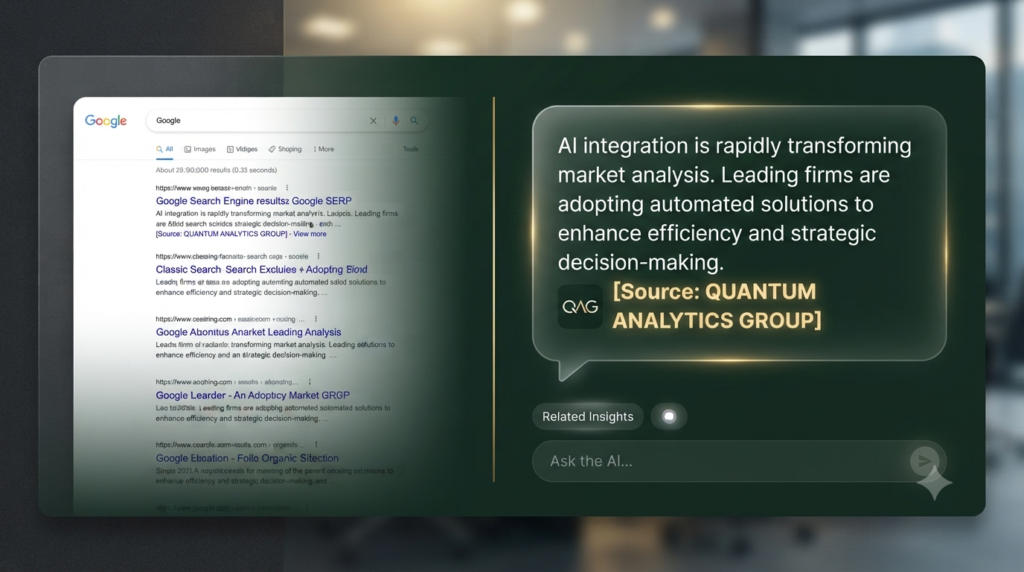
Here is the number that should be on every CEO’s dashboard: over 70% of brands have zero mentions in AI-generated answers even when they rank on page one of Google. Ranking and visibility have decoupled. You can win the old game and still lose the new one, invisibly, without a single alert or dashboard telling you it happened — unless you build the tracking system this article describes.
And the upside is just as real as the risk. Brands cited consistently in AI answers see a measurable lift in branded search volume in the following weeks, and that lift compounds the more consistently a brand is cited. Organizations that fully integrate AI visibility into their existing SEO, content, and communications programs report dramatically higher returns — roughly 81% see increased traffic or leads from AI platforms, compared with only about a third of organizations that manage AI visibility as a separate, siloed effort. This is not a niche marketing tactic. It is now core to enterprise growth strategy, on every continent, across every industry.
AI search has decoupled visibility from ranking — a brand can lead Google’s results and still be invisible in the AI-generated answer above them.
What Brand Visibility in AI Search Really Means
Before you can track something, you need a precise definition of it. “Brand visibility in AI search” is not one metric — it is a cluster of related but distinct signals, and confusing them is one of the most common strategic errors leadership teams make.
Mentions. This is the simplest signal: does an AI system say your brand’s name at all, in response to a relevant prompt? A mention can be neutral, positive, or negative, and it can appear with or without a link back to your site.
Citations. A citation is a mention with sourcing attached — the AI engine explicitly attributes a claim, statistic, or recommendation to your website or a piece of content you published. Citations are more valuable than mentions because they carry an implicit credibility transfer: the AI is telling the user “you can verify this yourself, here.”
Share of voice. This is your mention or citation frequency relative to your competitors, across a defined basket of prompts relevant to your category. Being mentioned is good; being mentioned more often, and more prominently, than the three brands your buyers are also considering is what actually shifts revenue.
Sentiment and framing. Not all visibility is good visibility. An AI engine can mention your brand while also surfacing a competitor as the superior choice, or while repeating outdated or inaccurate information about your offering. Tracking sentiment and framing — not just raw mention counts — is what separates a mature AI visibility program from a vanity metric.
Position and prominence. Where in the answer does your brand appear — is it the first name mentioned, one of several in a list, or a passing reference buried at the end? Position correlates strongly with actual influence on the buyer’s decision.
Consistency over time. This is the signal most leadership teams miss entirely. Research on repeated prompt testing shows that only around 30% of brands remain visible from one AI answer to the next on the same query, and only about 20% remain visible across five consecutive test runs. AI answers are probabilistic and dynamic, not static like a search ranking. A single positive result tells you almost nothing. A trend line across weeks tells you everything.
Generative Engine Optimization, or GEO, is the umbrella discipline for the practices that influence all five of these signals — the AI-era counterpart to SEO. Just as SEO was never one tactic but a system of technical, content, and authority signals working together, GEO is a system, and brand visibility tracking is how you measure whether that system is working.
Consider a composite illustration, drawn from patterns common across many real client audits rather than any single named company. Picture a fictional mid-sized business consulting firm, call it “Meridian Advisory,” that ranks on page one of Google for its core service terms and has done so for years. When its leadership team finally tested a set of buyer-relevant prompts against ChatGPT and Perplexity, they discovered their brand appeared in only 2 of 40 relevant prompts, while two much smaller regional competitors appeared in 18 and 24 prompts respectively. The reason was not quality of service — client outcomes were, by every account, excellent. The reason was structural: the smaller competitors had published comparison guides, been featured in three industry roundups the AI engines cited repeatedly, and maintained an active, substantive presence in a relevant professional community forum, while Meridian’s content lived almost entirely on brand-owned pages that AI engines rarely trusted as a primary source. This is exactly the kind of gap a proper tracking system exists to surface — quietly, before it costs a material share of new business.
A Quick Glossary for Your Leadership Team
Before you bring this to your board or executive committee, it helps to have shared vocabulary. These five terms will come up constantly in any serious AI search strategy conversation:
- AI Overview / AI Mode — the AI-generated answer summary that now appears directly within traditional search engine results, increasingly replacing the classic list of blue links for a large share of queries.
- Generative Engine Optimization (GEO) — the practice of structuring content and building authority so that generative AI systems are more likely to mention, cite, and favorably frame your brand.
- Answer engine — any AI system that generates a conversational response to a query rather than a ranked list of links, including ChatGPT, Gemini, Perplexity, Claude, and Microsoft Copilot.
- Entity signal strength — how clearly and consistently an AI system can identify who you are, what you do, and how you relate to your category, based on structured data, consistent naming, and third-party corroboration.
- Retrieval-ready content — content structured with clear headings, direct answers near the top, and verifiable data points, designed to be easily extracted and cited by an AI system rather than simply read by a human visitor.
What Leaders Should Track: The Five Signals That Matter
Translate the definitions above into an actual measurement agenda, and you get five categories every executive dashboard should include:
- AI mention rate — the percentage of a defined set of relevant prompts, tested across major AI engines, in which your brand is mentioned at all.
- AI citation rate — the percentage of those same prompts in which an AI engine specifically attributes information to a page you own or control.
- Share of voice versus named competitors — your mention and citation frequency as a proportion of the total mentions across your competitive set, tracked by category and by AI engine.
- Sentiment and accuracy — whether mentions are favorable, neutral, or unfavorable, and whether the AI is repeating accurate, current information about your brand or outdated or incorrect claims.
- Source influence — which third-party domains and content types the AI engines are citing when they answer questions about your category, because this tells you where you need to build presence even if you never touch your own website again.
That last point deserves emphasis because it surprises most executives the first time they see the data. Independent research on hundreds of thousands of AI citations has found that third-party content is cited roughly three times more often than brand-owned websites, and that AI answers draw on third-party sources in the overwhelming majority of cases — north of 90% by some university research.
Wikipedia is consistently the single most-cited source across engines, with Reddit now frequently the second most-cited source, ahead of most traditional media and far ahead of most brand websites. PR-driven coverage and social discussion are cited far more than corporate marketing pages. If your AI visibility strategy begins and ends with your own website, you are optimizing for a channel that AI engines trust the least.
Data Sources and Signals to Monitor
Building a tracking system means deciding, concretely, where the data comes from. There are five practical sources:
Direct prompt testing. Run a fixed, representative set of prompts — the actual questions your buyers ask — against ChatGPT, Gemini, Perplexity, Claude, and Microsoft Copilot on a regular cadence, and log whether, how, and where your brand appears. This is the foundation of any serious program.
AI visibility platforms. A growing category of specialized tools now automates prompt testing at scale, some running structured prompts daily across as many as nine answer engines and analyzing citation patterns across tens of millions of AI interactions. These platforms turn what would be an unmanageable manual task into a repeatable operating rhythm.
Search Console branded-query data. Because direct click-through from AI engines is typically minimal — often under 1% of visibility events — the real measurable ROI shows up as a lift in branded search volume in the weeks following AI citation. Tagging citation-detected dates and comparing branded impressions before and after is one of the highest-signal, lowest-cost tracking methods available to any team already using Google Search Console.
Third-party citation mapping. Track which domains, publications, review sites, and community platforms are being cited when AI engines answer questions in your category. This becomes your target list for PR, guest content, and community engagement.
Structured content audits. Because AI engines retrieve and parse content differently than human readers, monitor whether your key pages use clear headings, schema markup, direct-answer formatting, and up-to-date data — and track how citation rates change as you improve these technical signals.
The Step-by-Step Framework for Tracking Visibility
Here is a practical sequence you can hand to a marketing lead, an agency, or a solo strategist and have running within two weeks.
Step 1: Build your prompt library.
List 40 to 100 real questions your buyers ask before choosing a provider in your category — not keywords, actual conversational questions. Include branded prompts (“Is [Your Brand] good for X”), category prompts (“best [category] for enterprise buyers in [region]”), comparison prompts (“[Your Brand] vs [Competitor]”), and problem-based prompts (“how do I solve [core problem your product solves]”). Group them by funnel stage: awareness, consideration, and decision.
Step 2: Establish your baseline.
Before changing anything, run the full prompt library against ChatGPT, Gemini, Perplexity, and at least one other major engine. Record mention rate, citation rate, sentiment, position, and named competitors in each answer. This baseline is the single most important artifact in the entire process — you cannot prove improvement without it.
Step 3: Map your competitive set.
For every prompt where a competitor is mentioned and you are not, log which competitor, what specifically the AI credited them with, and which source it cited. This becomes your gap analysis and your content brief in one document.
Step 4: Identify your source gap.
Cross-reference the third-party domains cited across your prompt library. If AI engines are consistently citing three trade publications, a specific review platform, and Reddit discussions in your category, you now know precisely where your PR, community, and digital ecosystem efforts need to focus.

Step 5: Set a testing cadence.
Re-run the full prompt library on a fixed schedule — weekly for competitive categories, biweekly or monthly for slower-moving ones. Because AI answers fluctuate, a single test is a snapshot; a cadence is a trend line, and trend lines are what leadership decisions should be based on.
Step 6: Build the executive dashboard.
Reduce the raw data to five numbers leadership actually needs: overall mention rate, citation rate, share of voice versus your top three competitors, sentiment score, and month-over-month trend direction. Everything else is operational detail for the team executing the strategy, not for the boardroom.
Step 7: Close the loop with content and PR action.
Every gap identified in Steps 3 and 4 should generate a specific content brief, PR pitch, or technical fix — not a general resolution to “do more AI SEO.” As part of the wider AI transformation workforce agenda, the gaps you find in AI search should translate into team priorities, content workflows, and operating changes. Specificity is what separates a program that moves the needle from one that produces reports nobody acts on.
A simple seven-step cadence turns AI visibility from a mystery into a measurable, repeatable operating system.
Tools and Measurement Approach
You do not need to build this from scratch, and for most organizations you shouldn’t. The AI visibility tooling category has matured quickly, and the practical choice is less about which single tool is “best” and more about matching a tool’s depth to your organization’s stage.
Enterprise-grade, venture-backed platforms run structured prompts daily across many answer engines simultaneously — ChatGPT, Perplexity, Claude, Gemini, Copilot, and others — and increasingly connect visibility data to downstream conversion and revenue analytics, not just raw mention counts. These are appropriate for larger organizations with dedicated growth or content teams and a meaningful AI-driven pipeline to protect.
Mid-market and growth-stage tools typically track four to six engines on a weekly cadence, combine mention tracking with content workflow features, and are built for teams that want to move from “we see the gap” to “we’re closing it” without a large in-house data science function.
Lightweight and emerging tools are useful for smaller organizations or as a starting point — often with free trials — to establish a first baseline before committing budget to a larger platform.
Regardless of which tool tier fits your organization, insist on five capabilities before you commit budget: multi-engine coverage (not just one AI platform), citation-level detail (not just mention counts), competitor benchmarking built in, a defined testing cadence with historical trend storage, and an export or integration path into whatever dashboard your leadership team already reviews. A tool that produces beautiful reports nobody reads is worse than a spreadsheet your team actually updates every week.
A simple way to frame the decision for your team:
| Organization stage | What you need | Typical cadence |
|---|---|---|
| Early-stage/small team | Manual prompt testing in a shared spreadsheet, or a free-tier tool | Monthly |
| Growth-stage/dedicated marketing lead | Mid-market platform, 4–6 engine coverage, content workflow features | Weekly |
| Enterprise/multi-brand or multi-market | Venture-backed platform, daily multi-engine tracking, revenue attribution | Daily to weekly |
If you are not ready to commit to a platform yet, a manual version of Steps 1 and 2 above — run by hand, logged in a shared spreadsheet, refreshed monthly — is a legitimate and low-cost starting point. The discipline of tracking matters more than the sophistication of the tool in the first ninety days.
One more point worth an executive’s attention: measurement infrastructure is itself listed by researchers as one of the core factors separating brands that win consistent AI visibility from those that don’t, alongside content structure, platform-specific optimization, entity strength, technical performance, and third-party citation presence. In other words, the act of building a disciplined tracking system is not just a way of observing your AI visibility strategy — it is one of the six things that determines whether the strategy works at all.
How to Improve Visibility Once You Can See It
Tracking without action is just an expensive form of anxiety. Once your baseline and gap analysis are in hand, five levers consistently move the needle:
Publish content in the format AI engines actually cite. Structured comparison content, “best of” style roundups, and clear how-to formats are cited dramatically more often than standard product pages or corporate blog posts. This does not mean abandoning your brand voice — it means restructuring how you present expertise so it is retrievable, not just readable.
Win third-party citations deliberately. Because AI engines trust and cite third-party sources far more than brand-owned content, a PR and community strategy — trade press placements, credible review platforms, active and substantive participation in relevant online communities — is no longer a “nice to have” adjacent to your content strategy. It is now one of the primary levers of AI visibility itself.
Keep content fresh and specific. Content that isn’t updated on a regular cycle loses citations at a meaningfully higher rate than content refreshed quarterly. Specific, current data points outperform vague claims — AI systems are, at their core, pattern-matching machines that favor content offering a clear, quotable, verifiable answer.
Strengthen technical retrievability. Clear heading structures, direct-answer paragraphs near the top of a page, and schema markup all correlate with meaningfully higher citation rates. This is a genuinely technical workstream, and it belongs on your CTO’s or web team’s roadmap, not just your content calendar.
Build genuine topical authority, not isolated wins. The organizations winning most consistently in AI search are not the ones chasing a single viral prompt result — they are the ones building sustained, recognizable authority across an entire topic over time. Chasing a single favorable AI answer at the expense of your long-term organic and content foundation is, by the account of leading industry analysts, precisely the wrong trade to make.
Mistakes to Avoid
Even well-resourced teams make the same handful of errors repeatedly:
- Mistaking a single good result for a trend. Because AI answers fluctuate, one favorable mention proves almost nothing. Only a sustained pattern across repeated testing constitutes evidence of real visibility.
- Optimizing only your own website. Given how heavily AI engines lean on third-party sources, a strategy confined to your own domain is optimizing for the smaller half of the equation.
- Treating AI visibility as a side project of SEO. Organizations running AI visibility as an integrated part of their existing SEO, content, and PR programs report dramatically better results than those running it in isolation. Silos are the enemy of this discipline.
- Chasing vanity mention counts over sentiment and accuracy. A high mention rate paired with negative sentiment, outdated information, or consistent framing as the second choice behind a named competitor is not a win — it is a more urgent problem than invisibility, because it is actively shaping buyer perception in the wrong direction.
- Waiting for perfect data before acting. Teams that wait for an enterprise-grade platform, a full-year budget cycle, or complete certainty before starting lose months of ground to competitors already running a basic manual baseline today.
- No executive ownership. When AI visibility tracking sits three layers below the C-suite with no one accountable for the trend line, it withers into a report nobody reads. This has to be owned at the leadership level, the same way brand reputation and market share always have been.
- Confusing AI visibility with paid AI advertising. As AI platforms begin experimenting with sponsored placements and shopping integrations, some leadership teams assume they can simply buy their way into visibility the way they buy search ads. Earned citation and organic mention remain the dominant form of AI visibility today, and they are woPn through content, authority, and structure — not exclusively through media spend.
- Ignoring the accuracy problem. AI systems occasionally repeat outdated pricing, discontinued products, old leadership names, or superseded claims about your business, simply because that is what the training data or retrieved sources say. Part of any tracking program is a standing check for factual drift, with a clear internal process for correcting it — usually by publishing current, clearly dated, authoritative information that supersedes the stale version in the sources AI engines retrieve from.
Frequently Asked Questions From Leadership Teams
Q 1: How often should we actually re-test our prompts?
Weekly for a competitive category where visibility is actively being contested; monthly is an acceptable floor for a slower-moving or less contested category. Anything less frequent than monthly makes it very difficult to distinguish a real trend from ordinary fluctuation in AI answers.
Q 2: Do we need a different strategy for each AI engine?
Largely no. The underlying levers — structured content, third-party citation, technical retrievability, topical authority — improve visibility across nearly all major engines simultaneously, because they all reward similar underlying signals of trustworthiness and clarity. What differs is emphasis: some engines lean more heavily on real-time web retrieval, others more heavily on curated or licensed data partnerships, so a mature program tracks each engine individually even while pursuing one coherent underlying strategy.
Q 3: Is this replacing our SEO team, or working alongside it?
Alongside, and increasingly inseparable from it. The data is consistent on this point: organizations that integrate AI visibility into existing SEO, content, and PR functions dramatically outperform those that spin up a disconnected, standalone “AI team.” Treat GEO as the next chapter of your existing search and content discipline, not a separate department competing for the same budget.
Q 4: What is a realistic timeline to see movement in our numbers?
Because freshly published, well-structured content can begin generating citations within days in some cases, early movement is possible quickly — but durable, category-wide topical authority typically builds over one to two quarters of consistent execution, not a single sprint. Set your leadership team’s expectations accordingly, and reward the trend line, not any single week’s snapshot.
Global Business Implications
None of this is confined to any one market. Consumers and B2B buyers across North America, Europe, the Middle East, Africa, Asia, and Latin America are converging on the same behavior: checking multiple AI-adjacent sources before making a purchase or vendor decision, typically two or more platforms before committing. A founder in Lagos pitching investors, a manufacturer in São Paulo courting distributors, a fintech in Nairobi competing for enterprise clients, and a SaaS company in Singapore chasing global accounts are all now competing in the same AI-mediated discovery layer as their counterparts in New York or London.
This has two specific implications for leaders operating outside the largest, most saturated markets. First, because AI visibility in many categories and regions is still concentrated among a small number of brands — the top three players sometimes account for the overwhelming majority of category visibility in areas like news and consumer electronics — there is a genuine first-mover advantage available to brands willing to build structured, citation-worthy content and third-party authority now, before the category consolidates further. Second, because AI engines draw heavily on global sources like Wikipedia and international trade press rather than purely local media, a well-executed AI visibility strategy can help an ambitious brand outside a traditional media capital compete for global attention in a way that was structurally much harder in the search-engine-ranking era.
The AI search shift, in other words, is not simply a new marketing channel. It is a partial re-leveling of the global competitive field for discovery — and, like every re-leveling in business history, it rewards the leaders who move deliberately now over the ones who wait for the picture to become perfectly clear.
Consider a second composite illustration. A fictional fintech company, call it “Savanna Pay,” operating out of West Africa and competing for enterprise merchant accounts against both regional incumbents and larger multinational payment providers, ran its first AI visibility baseline and found something instructive: it was mentioned reasonably well on branded prompts, where its own name was already part of the question, but almost never appeared on category prompts like “best payment processor for cross-border e-commerce in Africa.”
The multinational competitors dominated those broader prompts, not because of superior product fit for the local market, but because their content had been aggregated into the international trade press and comparison sites that the AI engines were citing most heavily for that category. Savanna Pay’s response was not to try to outspend the multinationals — it was to invest deliberately in exactly the third-party sources the AI engines already trusted: contributing data and commentary to two relevant fintech industry reports, and publishing a detailed, well-structured comparison guide addressing cross-border merchant needs specific to its home market. Within two quarters of consistent execution, category-prompt visibility had moved meaningfully in its favor. The lesson generalizes well beyond fintech or any single region: the fastest path to AI visibility for a challenger brand is rarely to out-market the incumbent on its own turf, but to become an unavoidable, well-cited source on the specific sub-topics where the incumbent has not yet paid attention.
This dynamic plays out identically whether the underdog is a professional services firm in Manila, a specialty manufacturer in Poland, a healthtech startup in São Paulo, or a logistics brand in Dubai. AI engines do not care about the size of your marketing budget. They care about the clarity, structure, and third-party corroboration of the information available to them at the moment they generate an answer.
That is, in a very real sense, a more meritocratic system than the paid-media-driven discovery landscape it is replacing — provided your organization is disciplined enough to track it, understand it, and act on what it shows.
Practical Action Plan for Executives
If you take one thing from this article and act on it this week, make it this five-item action plan:
1. Assign ownership. Name one accountable person — internal or external — responsible for the AI visibility trend line, reporting on a fixed cadence to leadership.
2. Build the baseline this month. Run the 40-to-100 prompt library described above across at least three major AI engines and document exactly where you stand today.
3. Identify your three biggest gaps. Where are competitors visible and you are not? Where is sentiment working against you? Which third-party sources do you need to win?
4. Fund one lever, not five. Pick the single highest-leverage improvement from the list above — most often either structured content or third-party citation building — and resource it properly rather than spreading thin across everything at once.
5. Review the trend line quarterly, at minimum, at the leadership level. Treat it with the same seriousness as market share, churn, or pipeline coverage, because in every material sense, it now is one of those things.
Conclusion
Brand visibility in AI search is not a trend to monitor from a distance — it is already deciding, in real time, which brands get considered and which quietly disappear from the conversation before a prospective customer ever reaches your website.
The organizations that will lead their categories over the next several years are not necessarily the ones with the biggest existing brand or the biggest marketing budget. They are the ones disciplined enough to measure this channel with the same rigor they apply to revenue, and decisive enough to act on what the data shows before their competitors do.
You do not need a perfect system today. You need a baseline, a cadence, and someone accountable for the trend line. Build that this month, and you will already be ahead of the roughly 86% of brands still operating in this channel with no defined strategy at all.
If you are a CEO, founder, enterprise, entrepreneur, investor, company, or brand and you also need a content strategist to position your brand for visibility and growth, contact: ➡️info@digitalsuccesshub.org