
Why the Consulting Industry is Panicking Over AI-and What CEOs, Founders, and Business Owners Must Do Now.
Table of Contents
Introduction:
The message was clear: AI is killing the billable hour—and no one in that room was safe.
Let me start with a hard truth: AI is killing the billable hour—and if you’re a CEO, founder, or business owner, this is your survival guide.
There’s a particular kind of silence that happens in a room full of people who bill by the hour when someone tells them the hour is going away.
I’ve heard about that silence secondhand, from a friend who works in consulting, describing an internal town hall at one of the “Big Four” firms. Leadership put up a chart.
The chart showed the billable hour — the model the entire industry was built on — shrinking down to almost nothing by 2035, as AI agents absorbed more and more of the work that used to take a team of analysts a week to finish in an afternoon. One person in the room put it bluntly afterward: the message, even if never said in so many words, was that the old model was toast. For a moment, the strategy world just stood still.
If you want to understand how to shift your business strategy before 2035, read my complete breakdown of the 31x vs 13x: The AI Valuation Gap That Doubles Company Worth in 2026-it’s the framework I keep coming back to when I talk to clients about exactly this shift.
This isn’t a story about one consulting firm. It’s a preview. If the firms that taught the entire business world how to think about strategy are quietly rewriting their own business model, that tells you something about what’s coming for everyone else.
Whether you’re a CEO, a freelancer, a student deciding what to study, or a small business owner who’s never billed an hour of “strategy” in your life. The AI takeover isn’t a sci-fi headline anymore. It’s a spreadsheet in a conference room, and it’s already being projected ten years out.
What Actually Happened, In Plain English
For decades, professional services worked on a simple premise: smart people’s time is valuable, so you pay for their time.
An hour of a senior partner’s attention costs more than an hour of a first-year analyst’s, but either way, the clock is the product. It’s why your lawyer’s invoice itemizes phone calls in six-minute increments, and why a consulting engagement that takes longer than planned just… costs more.That model only works if human time is the scarce resource. AI agents are breaking that assumption.
Research, document review, financial modeling, first-draft strategy decks, competitive analysis — the kind of work that used to occupy junior staff for entire weeks can now be produced, reviewed, and refined in a fraction of the time.
Firms are responding by trying to sell outcomes instead of hours: fixed-price packages, subscriptions, “we’ll solve this problem for a flat fee” instead of “we’ll work on this problem for as long as it takes, and you’ll pay accordingly.” It’s a logical move, but it’s also a messy one — when a project runs over, the firm now eats the cost instead of passing it along. That’s a real financial risk, and it’s forcing a level of operational discipline the industry has never needed before.
So yes — the strategy world just stood still, for a beat, when that chart went up. And then, like every other industry that has faced a structural shift, it started moving again, just toward a different destination.
Why This Matters to You, Specifically
This is the part most coverage of “AI disrupts consulting” gets wrong: it treats this as a story about consultants. It isn’t. It’s a story about how value gets priced everywhere, and that affects almost everyone reading this. Students and early-career workers. If you’re choosing a degree or your first job right now, you’re choosing it in a market where “I can produce a competent first draft” is no longer a scarce skill — AI can do that part.
What remains scarce is judgment: knowing which draft is actually right, which assumptions are wrong, which client relationship needs careful handling, which numbers don’t smell right even though the model says they’re fine.
The students who treat AI as a research assistant and spend the time they save building real judgment will be in a completely different position in five years than the ones who treat it as a way to do less work.Local business owners. Local business owners. You were never billing by the hour, but you were almost certainly paying someone else who did — an agency, a bookkeeper, a consultant, a lawyer.
As those services restructure around fixed outcomes and AI-assisted delivery, expect pricing to become more predictable and, often, more affordable.
The advantage goes to small businesses that get comfortable asking vendors “what does AI handle in this, and what does a human actually own,” because that question now directly affects what you should be paying. CEOs and founders. The org chart built around layers of junior staff doing first-pass work is the layer most exposed to this shift. That doesn’t mean firing everyone — it means rethinking what junior roles are for.
The leaders who come out ahead are treating this as a capability-building moment: using AI to compress the grunt work and reinvesting the freed-up time and budget into things that still require a human in the loop — relationships, judgment calls, accountability. Enterprises and large organizations: You are both a buyer of professional services and, increasingly, a competitor to them. Plenty of large companies are building internal AI-augmented teams that do work they used to outsource to the very firms now panicking about their own billable hours.
If you’re an enterprise leader, the question isn’t “should we use AI” anymore — it’s “which decisions still need to leave the building, and which ones don’t.”. Investors: Watch how professional services firms talk about their own margins over the next few years.
A firm that successfully shifts from hourly billing to value-based, AI-augmented pricing should, in theory, see margin expansion — they’re delivering similar value with lower internal cost.
A firm that clings to the billable hour while clients increasingly expect AI-era pricing will get squeezed from both sides. That’s a real signal worth tracking in earnings calls and investor updates, not just press releases. Brands, globally and locally: Whether you’re a multinational or a single-location business, the AI takeover changes what “responsive” and “personalized” mean to your customers.
A small bakery using AI to handle inventory forecasting and a global brand using it to localize marketing in forty languages overnight are doing versions of the same thing: using the technology to act like a much bigger, much faster organization than their headcount would suggest.
The Old Model vs. the New Model
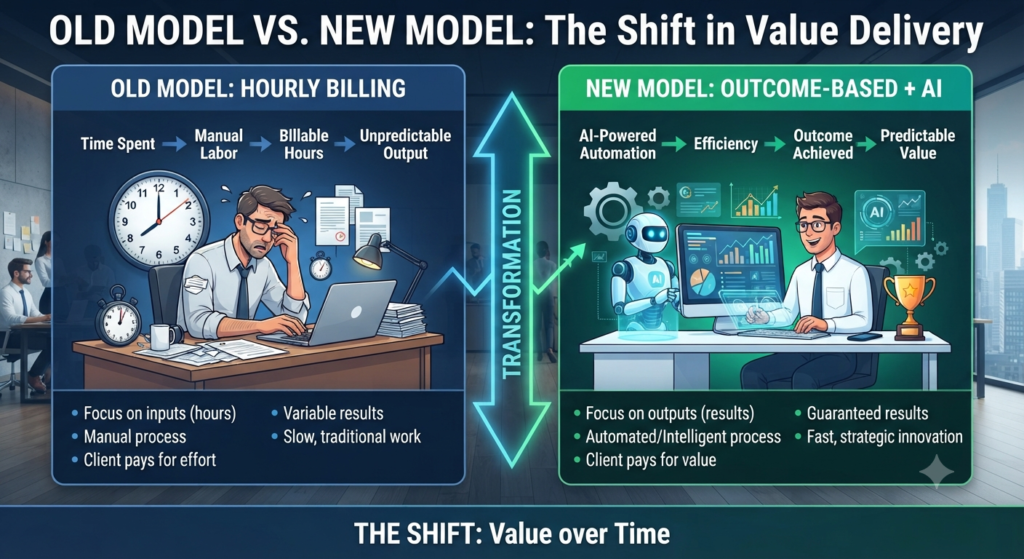
The old model rewarded time spent. The new model rewards the gap closed between a problem and its solution — and AI is what’s closing that gap faster.
This is the single biggest mental shift required right now, for individuals and organizations alike: stop asking “how many hours will this take,” and start asking “what is this actually worth, and how fast can we responsibly get there.”
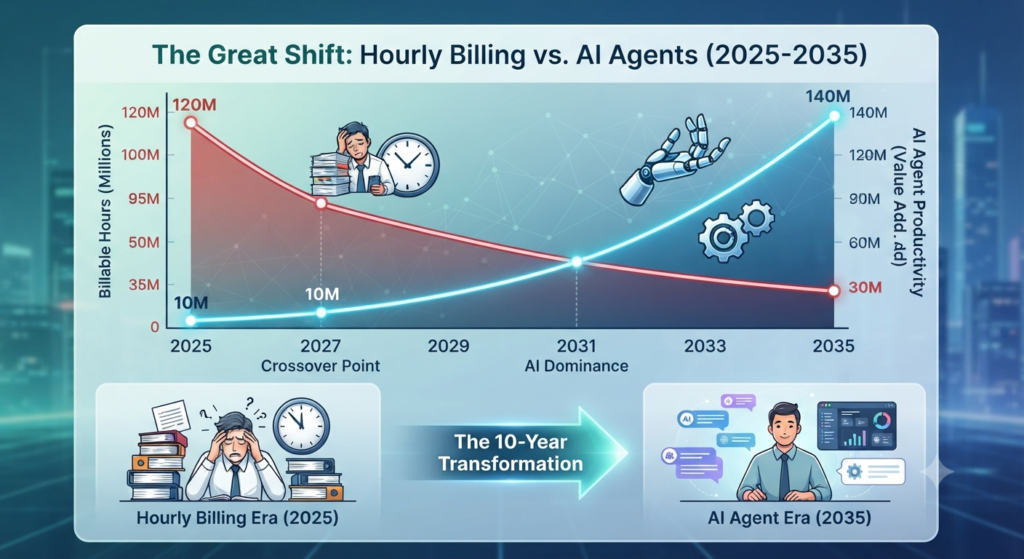
That chart from the town hall isn’t really about one firm’s internal projections. It’s a preview of a curve that’s going to show up, in some form, across law, accounting, marketing, design, and beyond.
The firms moving early are trying to get ahead of it rather than be flattened by it.
If you’re a student or early-career professional: build a portfolio of judgment, not just output. Use AI tools constantly, but document the decisions you made on top of what they gave you. That’s what gets you hired when “can produce a deliverable” stops being differentiating.
If you’re a local business owner: audit every service you pay for by the hour. Ask each vendor directly what part of their process is AI-assisted, and whether a fixed-price or outcome-based version of the engagement exists. You may be paying for inefficiency you didn’t know was there.
If you’re a CEO or founder: map your org chart against “tasks that benefit from AI compression” versus “decisions that require accountable human judgment.” Reinvest the time saved from the first category directly into strengthening the second — don’t just bank it as cost savings and stop there.
If you’re running or scaling an enterprise: build internal AI fluency before you build more vendor dependency. The organizations with the most leverage over the next decade will be the ones who can credibly decide, project by project, whether to build, buy, or augment.
If you’re an investor: treat “we’re shifting to value-based pricing” as a claim to verify, not a tagline to accept. Look for actual evidence of margin and delivery-time changes, not just messaging.
If you’re a brand, local or global: use the freed-up capacity from AI-assisted operations to invest in the parts of customer experience that still require a genuinely human touch — because as more competitors automate the easy parts, the human parts become the differentiator again.
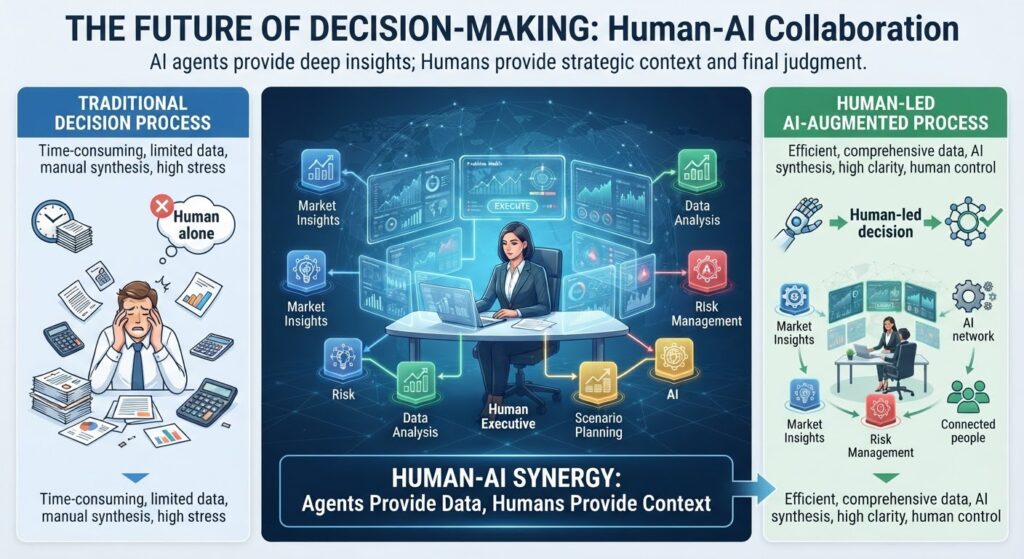
It’s Not About Hours Anymore
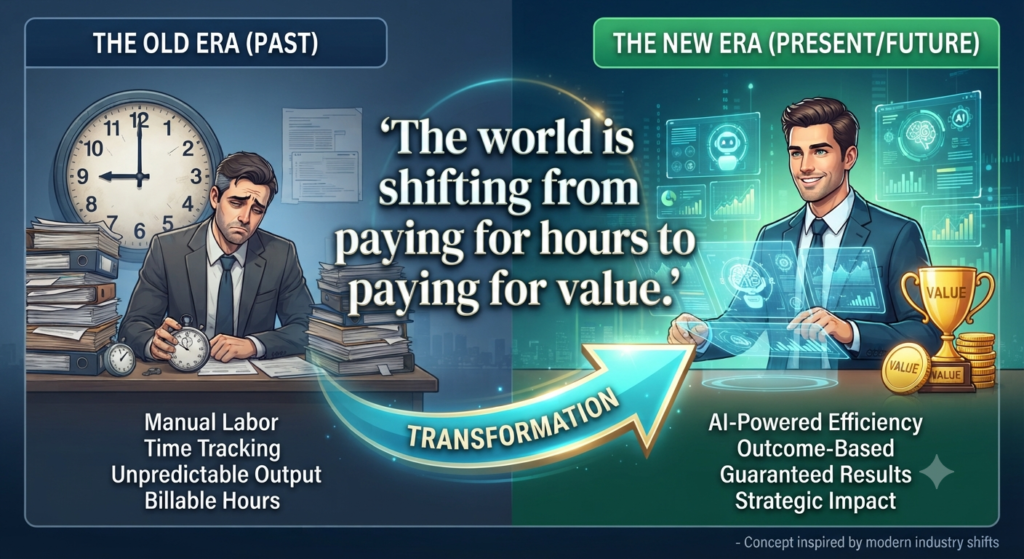
The deepest shift here isn’t technological — it’s psychological. An entire generation of professionals was trained to think of their value in units of time.
The next decade is going to retrain everyone, gradually and sometimes uncomfortably, to think of value in units of outcome instead. That’s uncomfortable for anyone who built a career on being busy. It’s an opportunity for anyone willing to get good at being useful.
A Forward-Looking Close
The strategy world stood still for a moment when that chart appeared on a screen in a conference room. It won’t stand still for long.
Every industry built around selling time is going to face some version of this same reckoning over the next decade, and the businesses, professionals, and investors who treat it as a planning exercise now — rather than a crisis to react to later — are the ones who’ll come out ahead of the AI takeover instead of behind it.
This shift rewards people who move early, not people who move loudest. You don’t need to have all the answers today. You need a roadmap, and the discipline to revisit it as the landscape keeps changing.
Frequently Asked Questions
Q 1: Is the billable hour actually going away completely?
Not overnight, and probably not entirely. What’s shrinking is its dominance as the default way professional services are priced. Hourly billing will likely persist for highly specialized, unpredictable, or judgment-heavy work, while routine and research-heavy work moves toward fixed or outcome-based pricing.
Q 2: Does this mean AI is replacing consultants, lawyers, and analysts?
It’s replacing tasks more than it’s replacing people — first drafts, research compilation, basic modeling. The roles that survive and thrive are the ones that shift from “doing the work” to “directing, validating, and taking accountability for the work.”
Q 3: How should a small business owner respond to this right now?
Start by asking every professional services vendor you use whether AI is part of their delivery process, and whether that’s reflected in pricing. You may find opportunities to renegotiate or switch to more efficient, outcome-based arrangements.
Q 4: What should students study if this shift is coming?
There’s no single “safe” degree. What matters more than the subject is whether your education builds judgment, communication, and the ability to evaluate AI output critically — skills that apply across nearly every field.
Q5: Is this trend specific to the “Big Four” consulting firms, or broader?
It started becoming visible there because those firms are large, well-documented, and built almost entirely around the billable hour. But the same pressure applies to law firms, marketing agencies, accounting practices, and any service business that sells time.
Q 6: What’s the single biggest mistake businesses make in responding to this shift?
Treating it as a cost-cutting exercise instead of a value-creation one. Cutting headcount without reinvesting saved capacity into stronger judgment, relationships, and accountability just produces a smaller, weaker version of the same old model.
The Old Model vs. The New Model “The shift is undeniable: AI is killing the billable hour, and the only question is how fast you adapt.
The truth is simple: AI is killing the billable hour. The winners will be those who embrace it.
If you want to understand how to shift your business strategy before 2035, read my complete breakdown of the 31x vs 13x: The AI Valuation Gap That Doubles Company Worth in 2026 and if you’d rather talk it through directly, Book a Free 30-Minutes Call ⬇️ https://calendly.com/digitalsuccesshub-info/30min